As I read about the physicists' dismay at the possibility of our "accidental universe" amid myriad possible universes, I am puzzled over what we expect to find, ultimately, in so-called fundamental particles or laws. After all, what physical law could be so fundamental as to entail the existence of something rather than nothing?
The human mind has two explanatory needs, one for cause-and-effect and the other for narrative meaning, but it seems to me that both of these cannot be satisfied at the same time. Science does a marvelous job of explaining the behavior of matter within the range of conceivable human experience, but as we pursue cause-and-effect into the remoteness of time and abstraction, science leads to infinite regression. At a certain point, neither the Big Bang nor the infinite multiverse suffices as explanation; one can only say that there is something rather than nothing and that is that. We don't know why.
Narrative accounts on the other hand may gratify the basic emotional need for explanation, but then science goes out the window. There is something rather than nothing because God is in all places and all times--on this view a warm glow of necessity takes the place of the implacably arbitrary.
We have evolved as both calculating and valuing creatures, but these local faculties, while estimable in the human milieu, bear diminishing power into the deeps of space and time.
Showing posts with label Spirituality. Show all posts
Showing posts with label Spirituality. Show all posts
Wednesday, January 11, 2012

Tuesday, September 6, 2011
The Religion of the Good, Part 2
A recent New Yorker profile of the philosopher Derek Parfit mentioned that the late Bernard Williams once dismissed the ideal of a universally compelling moral code as (I paraphrase) "something you use on the men who come to take you away." Indeed, implied in the "problem of evil" is the conviction (or fantasy perhaps) that if we could only find the right combination for the great moral mystery vault, the ponderous door of error would swing open, releasing a radiance that would burn away the scales from the eyes of the benighted.
I imagine that some religious believers have a similar feeling that if they could only depict or praise God rightly, his existence and glory would be as plain to everyone else as they are to them. The holy grail of thought is the proposition (or grand scheme of propositions) that is as self-evident as 2 + 2 = 4 but as transcendent and as life-changing as the existence of God. That is the constructed idea(l) that we imagine would stop the bad men in their tracks and bring them to their knees. If God does not exist, then it will be necessary to invent (it)--this is the project that is at least implicit in non-relativistic philosophy. As Wallace Stevens wrote, "One day they will get it right at the Sorbonne."
I once read a review by Helen Vendler in which she claimed that the role of the critic is not only (or even primarily) to explain or to justify, but also to celebrate. Similarly, I think that for anyone who reflects seriously about the moral life, explanation and justification go only so far, beyond which point one can only aspire to praise and embody one's views. The barbarians who burn down the monastery are unfazed by the crucifix; likewise, no secular moral system achieves the potency of a talisman. To accept this is also to accept a troubling existential diversity in human nature--other people see the great questions in the same way that I do, except when they don't do so at all. Perhaps the Tower of Babel is the central metaphor for humanity, making us the most atypical species. There is a strain in philosophy that seeks to tear down the tower in favor of a second Garden of Eden, done rightly this time.
The problem is that many men (most of them, alas, have been men) have been sure that they beheld the Truth, and terrible things have been done in the name of Truth. The point is to religiously (in the generic sense) embrace a system of meaning while avoiding clinical or moral insanity. Just as Satanism may be an internally consistent religion, so may there be functioning philosophies of evil (National Socialism, al Qaeda, etc.). We denounce them not because they have no justification (they do have their internal justifications), but because we find them pernicious and repugnant. Our grounds for doing so may be ultimately contingent on the creatures that we evolved to be, but that is the best we can do--we can never escape history by inventing ourselves de novo. By and large, we also happen contingently to find the blues and golds of sea, sky, and sun to be gratifying, and we can only be grateful that we do so. The truth is not given in any simplistic way, but there is also no truth that does not derive, in some fantastically complicated way and filtered through many generations of human consciousness, from our origin.
I imagine that some religious believers have a similar feeling that if they could only depict or praise God rightly, his existence and glory would be as plain to everyone else as they are to them. The holy grail of thought is the proposition (or grand scheme of propositions) that is as self-evident as 2 + 2 = 4 but as transcendent and as life-changing as the existence of God. That is the constructed idea(l) that we imagine would stop the bad men in their tracks and bring them to their knees. If God does not exist, then it will be necessary to invent (it)--this is the project that is at least implicit in non-relativistic philosophy. As Wallace Stevens wrote, "One day they will get it right at the Sorbonne."
I once read a review by Helen Vendler in which she claimed that the role of the critic is not only (or even primarily) to explain or to justify, but also to celebrate. Similarly, I think that for anyone who reflects seriously about the moral life, explanation and justification go only so far, beyond which point one can only aspire to praise and embody one's views. The barbarians who burn down the monastery are unfazed by the crucifix; likewise, no secular moral system achieves the potency of a talisman. To accept this is also to accept a troubling existential diversity in human nature--other people see the great questions in the same way that I do, except when they don't do so at all. Perhaps the Tower of Babel is the central metaphor for humanity, making us the most atypical species. There is a strain in philosophy that seeks to tear down the tower in favor of a second Garden of Eden, done rightly this time.
The problem is that many men (most of them, alas, have been men) have been sure that they beheld the Truth, and terrible things have been done in the name of Truth. The point is to religiously (in the generic sense) embrace a system of meaning while avoiding clinical or moral insanity. Just as Satanism may be an internally consistent religion, so may there be functioning philosophies of evil (National Socialism, al Qaeda, etc.). We denounce them not because they have no justification (they do have their internal justifications), but because we find them pernicious and repugnant. Our grounds for doing so may be ultimately contingent on the creatures that we evolved to be, but that is the best we can do--we can never escape history by inventing ourselves de novo. By and large, we also happen contingently to find the blues and golds of sea, sky, and sun to be gratifying, and we can only be grateful that we do so. The truth is not given in any simplistic way, but there is also no truth that does not derive, in some fantastically complicated way and filtered through many generations of human consciousness, from our origin.
Monday, September 5, 2011
The Religion of the Good
A couple of weeks ago, in the New York Times philosophy feature "The Stone," Joel Marks confessed his loss of faith in objective morality:
"I thought I was a secularist because I conceived of right and wrong as standing on their own two feet, without prop or crutch from God. We should do the right thing because it is the right thing to do, period. But this was a God too. It was the Godless God of secular morality, which commanded without commander--whose ways were thus even more mysterious than the God I did not believe in, who at least had the intelligible motive of rewarding us for what He wanted us to do." (Italics in original).
Marks goes on to claim that even if we withdraw the quasi-theistic vehemence of our confidence in objective morality, and thus acknowledge the mere contingency of our beliefs, this needn't change our actual practice. We continue to believe what we believe and have the right to advocate our views in accord or in competition with others, but according to Marks, we can never claim that the views of others are wrong, only that they lead to different consequences. Such advocacy would seem able to achieve moral consistency, and not full justification. For instance, Marks notes animal welfare as one of his central preoccupations. Alluding to the basic moral tenet that avoidable suffering is wrong, one may educate others about animals' lives in factory farms, but not add the emotional force of moral disapprobation (which, Marks maintains, may provoke resistance or resentment as much as anything).
I think that this is wrong and that it mistakes human moral development. At a certain level we embrace certain traditions, rituals, and moral standards not because we pretend to ultimate moral justification of them, but because the alternative is chaos. We raise our children to believe that certain behaviors are not merely different from what we happen to do--they are wrong. We watch football rather than soccer by virtue of mere geographic contingency; while we may prefer football, we recognize that this is likely due to acculturation and habituation. But when we say that it is not right to abuse animals, we assert that this true everywhere and for everyone.
Secular morality does therefore partake of the emotional conviction of religious faith, but this reflects its fervor, not its groundlessness, and hence is a mark of strength and not weakness. The "God" of secular morality is an impersonal ideal that we collectively construct, not a personal interlocutor that we discover. There are, of course, many versions of this "God" just as there are many versions of the God of the Christian church (and obviously Islam and Judaism). But I think there can therefore be a fundamental secular referent of the term "Godless," which denotes not merely he who lacks faith in the supernatural, but he who is unable or unwilling to shape his behavior according to moral ideals and/or the suffering of others (conduct which we may designate as psychopathic or evil).
Near the beginning of Terence Malick's "The Tree of Life," the narrator comments that there are those who live in a "state of nature" and those who live in a "state of grace." We live in a "state of nature" insofar as we merely gratify our impulses, even if to the detriment of others, or complacently embrace our (evolutionarily) contingent dispositions. And there is a secular version of the "state of grace" whereby we believe ourselves to be free to (collaboratively) fashion a moral ideal.
The "religion" of secular ethics is prey to the same pathologies as conventional religion, i.e. propensities to rigidity, dogma, self-righteousness, hypocrisy, and exclusion. But it is also offers the same potential for affiliation and transcendence (if not, granted, the same degree of narrative interest or life-after-death consolation). I consider myself agnostic because I do not find any of the world's supernatural deities to be existentially compelling, but my attachment to, say, the Golden Rule (among other moral precepts) does have, as Joel Marks rightly argues, a good deal of faith to it. But inasmuch as there can really be no doubt as to whether the Golden Rule exists, this my attitude could be said to involve love more than belief.
"I thought I was a secularist because I conceived of right and wrong as standing on their own two feet, without prop or crutch from God. We should do the right thing because it is the right thing to do, period. But this was a God too. It was the Godless God of secular morality, which commanded without commander--whose ways were thus even more mysterious than the God I did not believe in, who at least had the intelligible motive of rewarding us for what He wanted us to do." (Italics in original).
Marks goes on to claim that even if we withdraw the quasi-theistic vehemence of our confidence in objective morality, and thus acknowledge the mere contingency of our beliefs, this needn't change our actual practice. We continue to believe what we believe and have the right to advocate our views in accord or in competition with others, but according to Marks, we can never claim that the views of others are wrong, only that they lead to different consequences. Such advocacy would seem able to achieve moral consistency, and not full justification. For instance, Marks notes animal welfare as one of his central preoccupations. Alluding to the basic moral tenet that avoidable suffering is wrong, one may educate others about animals' lives in factory farms, but not add the emotional force of moral disapprobation (which, Marks maintains, may provoke resistance or resentment as much as anything).
I think that this is wrong and that it mistakes human moral development. At a certain level we embrace certain traditions, rituals, and moral standards not because we pretend to ultimate moral justification of them, but because the alternative is chaos. We raise our children to believe that certain behaviors are not merely different from what we happen to do--they are wrong. We watch football rather than soccer by virtue of mere geographic contingency; while we may prefer football, we recognize that this is likely due to acculturation and habituation. But when we say that it is not right to abuse animals, we assert that this true everywhere and for everyone.
Secular morality does therefore partake of the emotional conviction of religious faith, but this reflects its fervor, not its groundlessness, and hence is a mark of strength and not weakness. The "God" of secular morality is an impersonal ideal that we collectively construct, not a personal interlocutor that we discover. There are, of course, many versions of this "God" just as there are many versions of the God of the Christian church (and obviously Islam and Judaism). But I think there can therefore be a fundamental secular referent of the term "Godless," which denotes not merely he who lacks faith in the supernatural, but he who is unable or unwilling to shape his behavior according to moral ideals and/or the suffering of others (conduct which we may designate as psychopathic or evil).
Near the beginning of Terence Malick's "The Tree of Life," the narrator comments that there are those who live in a "state of nature" and those who live in a "state of grace." We live in a "state of nature" insofar as we merely gratify our impulses, even if to the detriment of others, or complacently embrace our (evolutionarily) contingent dispositions. And there is a secular version of the "state of grace" whereby we believe ourselves to be free to (collaboratively) fashion a moral ideal.
The "religion" of secular ethics is prey to the same pathologies as conventional religion, i.e. propensities to rigidity, dogma, self-righteousness, hypocrisy, and exclusion. But it is also offers the same potential for affiliation and transcendence (if not, granted, the same degree of narrative interest or life-after-death consolation). I consider myself agnostic because I do not find any of the world's supernatural deities to be existentially compelling, but my attachment to, say, the Golden Rule (among other moral precepts) does have, as Joel Marks rightly argues, a good deal of faith to it. But inasmuch as there can really be no doubt as to whether the Golden Rule exists, this my attitude could be said to involve love more than belief.
Monday, September 27, 2010
Becoming Who You Are

Sean Wilentz's Bob Dylan in America (excerpt here from The Daily Beast) is a worthy review of that force of nature, offering not a comprehensive examination (which will some day run to many volumes), but a series of deep core samples, as it were, taken from representative phases of Dylan's tortuous and protean career.
Dylan's story is a half-century version of Seinfeld's "show about nothing," that is, he is the trickster irrationalist, the artiste supreme, resisting every categorization. He is about nothing but sheer exuberant creativity, following his own quiddity, throwing off songs as a fire throws off sparks. For him there is only history, human nature, and the music driving the flower through the green fuse. He speaks endlessly but does not answer questions (as such, he is a kind of ultimate counter-example to psychiatry, or perhaps rather a competitor, the great blank screen and arch-therapist).
In parallel, D. G. Myers at A Commonplace Blog neatly identifies the dilemmas of religious toleration vs. tolerance. A deeply religious man to judge from his writing, he points out that all theological justification is logically circular, and there is no arguing first principles; in a process that apparently remains mysterious, one finds oneself either inside or outside of a belief system. So religious toleration is the recognition that one has nothing to fear from other faiths outside of coercion and violence.
What do Dylan and religion have in common? For me, it is the realization that there is finally nothing outside of nature, attachment, and seduction. I mean the latter not in any manipulative sense, but in the sense that not only art, but also persuasion and reason, are attempts to beckon others hither, to say, "Look at this wondrous state of being, if only it could be realized."
Sunday, September 12, 2010
Conundrums and Credulity

A couple of recent links usefully examine the empirical and moral implications of religious belief. Tim Crane considers the ambiguous relation of faith and evidence, pointing out that while a demanding need for evidence for God is seen to reflect a fragile faith, it is nonetheless the case that religion collapses without a crucial intersection between the supernatural and the historical record.
John Cottingham, reviewing books by Mark Johnston and Andre Comte-Sponville (unread by me), suggests the paradoxical moral effects of specific belief. His review reminds us that belief in a personal God, with its implied promises of salvation and heavenly reward, cannot escape entirely the taint of idolatry and self-interest. The highest, most heroic spirituality would be that which conducts itself as if God existed while relinquishing any actual belief that this is the case. That is, the truest Christian, even if it could somehow (impossibly) be conclusively demonstrated that Jesus Christ was merely a man, would go on just as before.
However, Cottingham argues, in a way that is probably familiar to readers of this blog, that without the existential anchor of actual theistic belief, religion loses all specific content and disintegrates into well-meaning but empty notions of the life force. And worse, he claims that the project of a fully secular ethics is ultimately doomed, that without the foundation of communal faith underlying Western civilization, the elaborate complexities of Locke, Kant, etc. have no binding force.
This introduces a paradox of morality: so long as it is buttressed by a personal God (who by implication may dole out rewards and punishments), it is primitive and tribal in nature, but if God is jettisoned, morality becomes metaphysically optional. Cottingham clearly prefers the former as the lesser of two evils. Of those who, like myself, are non-believers yet do not routinely indulge our worst impulses, he would presumably say that we are either merely timid or are ungratefully coasting on a sense of decorum stemming ultimately from the Western faith we profess to be unmoved by.
I guess I see secular morality as a historically novel trend, as unprecedented in our ancient evolutionary history as, say, scrupulous regard for the welfare of animals or acceptance of antipodal human beings as something other than targets for conquest. I think that the emotional roots of religion are biologically deep, but that they can find other soil than historical theism. After all, the historical specificity of faith accentuates the paradox of religious tolerance: if a Christian truly believed that a Muslim's tradition were as valid as his own, he would have no compelling reason to remain a Christian. Instead, he consents to respect the Muslim point of view, but for reasons of social concord that lie outside of faith itself; for monotheistic gods are inherently jealous.
But to return to Crane's point about history and faith, it is important to recall that belief cannot avoid being mediated through and through, as the crucial roles of Scripture and the Koran reveal. When I say that I do not believe in Allah or the Christian God, I am really saying that I do not believe that the assembled writings of various Middle Easterners of 1300 or 1800 years ago reveal anything more than compendia of hearsay. It is not God that I disbelieve in; it is a specific historical product of deeply fallible humanity that I disbelieve in. Similarly, those who profess to believe actually subscribe to a particular and all-too-human historical tradition, in the absence of which religion sublimates into a vapor of vague feeling.
It could also be said that I (presumptively perhaps) await the one and true religion, which will come after all of these false starts. I propose a return to the Egyptians, those worshippers of cats and of the sun.
Sunday, August 29, 2010
Just Because

Some say they're goin' to a place called Glory and I ain't saying it ain't a fact
But I've heard that I'm on the road to purgatory and I don't like the sound of that
Well, I believe in love and I live my life accordingly
But I choose to let the mystery be
Iris Dement
I have in mind a couple of posts on psychotherapy and meds, but for today just another piggyback on NPR's excellent 13.7 blog, where Ursula Goodenough posts on matters of ultimate questions. Her last name, while not in fact made up for this post, is eminently suitable and must have had an effect on her formative development (unless, oops, it is her married name).
Her post about her own "covenant with mystery" is interesting in its own right, but I was particularly struck by her quote from an unnamed contributor to a listserv at the "Institute on Religion in an Age of Science," for the comment expresses, more clearly and succinctly than I have achieved, the ecology of belief:
While theism per se may seem irrelevant from several perspectives, the impulse underlying it is not. The concept of a personal God is one way of envisioning the ultimate source or organizing force of all that is. Many feel this image has flaws. But unless an alternative is adopted in its place, the absence leaves a Big Question, and gaping holes in understanding/belief are uncomfortable. I agree that understanding or appreciating Reality does not require Theistic causality. But, until a naturalist perspective can offer some type of image of the ultimate that can both be grasped and feel right, it will remain lacking in something essential.
As Goodenough notes, there is an irreducible subjectivity to belief, relating to how it makes one feel; it is a deeply personal matter, as much so as the kind the person one falls in love with. For agnostics, theism does not "feel right," whereas for believers it does, or at least it feels right enough. Similarly, for me naturalism feels good enough, but I recognize that this puts me in the distinct minority, both historically and currently (and perhaps futuristically as well).
Today's loud atheists, the Richard Dawkinses and Daniel Dennetts of the world, are good scientists and philosophers but poor psychologists. Projecting their mentalities upon mankind, they would deprive the majority of their spiritual bread while putting in its place something that, for that majority, tastes of ashes.
I think it was Emerson who wrote somewhere that the genius believes that what is true of himself is true of all humanity. Yes, there is overlap between genius and narcissism, but it is only partial.
Sunday, August 22, 2010
Sunday School

"The whole of existence frightens me," protested the philosopher Soren Kierkegaard; "from the smallest fly to the mystery of the Incarnatiion, everything is unintelligible to me, most of all myself." By contrast, the evolutionary reductionist Ernst Haeckel, writing in 1877, commented that "the cell consists of matter...composed chiefly of carbon with an admixture of hydrogen, nitrogen and sulphur. These component parts, properly united, produce the soul and body of the animated world, and suitably nourished become man. With this single argument the mystery of the universe is explained, the Deity annulled and a new era of infinite knowledge ushered in." Since these remarks of Haeckel's, uttered a hundred years ago, the genetic alphabet has scarcely substantiated in its essential intricacy Haeckel's carefree dismissal of the complexity of life. If anything, it has given weight to Kierkegaard's wary statement or at least heightened the compassionate wonder with which we are led to look upon our kind.
"A conviction akin to religious feeling of the rationality or intelligibility of the world lies behind all scientific work of a high order," says Albert Einstein. Here once more the eternal dichotomy manifests itself. Thoreau, the man of literature, writes comopassionately, "Shall I not have intelligence with the earth? Am I not partly leaves and vegetable mould myself?" Or Walt Whitman, the poet, protests in his Song of Myself: "whoever walks a furlong without sympathy walks to his own funeral drest in a shroud."
Loren Eiseley, from "Science and the Sense of the Holy"
Friday, August 20, 2010
Unanswerables
"The mystical is not how the world is, but that it is."
Wittgenstein
Marcelo Gleiser at NPR's 13.7 blog speculates about the ultimate inability of science to explain the first cause of the universe. The fact that there is something rather than nothing may not be a demonstrably empirical matter. I suppose the three great and still unsolved questions are: the origin of the universe, the inception of life, and the development of consciousness. Many have suggested that our minds may not be structured to solve some puzzles, ever.
Of the three, it seems to me that in the long run biology itself, the coming into being from the lifeless muck of self-replicating and eventually self-assembling organic systems, will be the "easiest" to account for. And I think that over time, even if it takes centuries, we will arrive at a decent understanding of how neural networks generate subjectivity, although the specifics of individual subjectivity will always retain some obscurity inasmuch as a particular consciousness is epistemologically a self-enclosed system (i.e. no outside agent could fully understand what it is to be me without in fact becoming me and in the process ceasing to be himself).
But the source of reality itself is a totally different kind of question, and one that may not in fact be scientific at all. For me the strangeness of the matter is that I can't even imagine what an explanation for the universe would look like or how it could possibly be satisfactory. One possibility is that the universe (or rather some grand multiverse from which our universe sprang) has always existed. But somehow I find this kind of infinite regress distasteful. In fact, infinity itself is distasteful except in the abstract.
However, neither am I happy with the notion that the universe had a specific origin, before which or outside of which there was truly nothing (such that "before which" or "outside of which" have no meaning inasmuch as time and space do not exist outside of the universe). The human brain evolved with assumption of limits and of agents. Theistic accounts of creation, while intellectually unsatisfactory in all sorts of ways, nonetheless are easier to relate to. It is somehow emotionally easier to imagine that a stipulated God has simply always been than that a neutral multiverse has always been. I'm not sure why this would be so.
I have the same problem, actually, with space. That is, it is equally disturbing to imagine the universe as spatially infinite as it is to imagine that it would be even theoretically possible to arrive at a physical point beyond which there is non-being. That suggests that time and space are simply limiting frameworks of my contingent mind. So speculating about why the Big Bang happened or where it came from may be like aspiring to stare directly (without mirrors, etc.) at the back of my head.
No, I haven't been getting high or reading Heidegger. But philosophy is a kind of willful stupidity, the refusal to accept the obvious as obvious. To ask why reality not only follows abstract physical laws, but also exists at all (which is not required by those laws) is something like asking how one knows reality is "out there" at all rather than a mere dream or illusion of consciousness; both questions vainly seek for something within experience to justify the basic condition of experience at all. And with that one leaves the desert of philosophy for an oasis of common sense, and the weekend.
Wittgenstein
Marcelo Gleiser at NPR's 13.7 blog speculates about the ultimate inability of science to explain the first cause of the universe. The fact that there is something rather than nothing may not be a demonstrably empirical matter. I suppose the three great and still unsolved questions are: the origin of the universe, the inception of life, and the development of consciousness. Many have suggested that our minds may not be structured to solve some puzzles, ever.
Of the three, it seems to me that in the long run biology itself, the coming into being from the lifeless muck of self-replicating and eventually self-assembling organic systems, will be the "easiest" to account for. And I think that over time, even if it takes centuries, we will arrive at a decent understanding of how neural networks generate subjectivity, although the specifics of individual subjectivity will always retain some obscurity inasmuch as a particular consciousness is epistemologically a self-enclosed system (i.e. no outside agent could fully understand what it is to be me without in fact becoming me and in the process ceasing to be himself).
But the source of reality itself is a totally different kind of question, and one that may not in fact be scientific at all. For me the strangeness of the matter is that I can't even imagine what an explanation for the universe would look like or how it could possibly be satisfactory. One possibility is that the universe (or rather some grand multiverse from which our universe sprang) has always existed. But somehow I find this kind of infinite regress distasteful. In fact, infinity itself is distasteful except in the abstract.
However, neither am I happy with the notion that the universe had a specific origin, before which or outside of which there was truly nothing (such that "before which" or "outside of which" have no meaning inasmuch as time and space do not exist outside of the universe). The human brain evolved with assumption of limits and of agents. Theistic accounts of creation, while intellectually unsatisfactory in all sorts of ways, nonetheless are easier to relate to. It is somehow emotionally easier to imagine that a stipulated God has simply always been than that a neutral multiverse has always been. I'm not sure why this would be so.
I have the same problem, actually, with space. That is, it is equally disturbing to imagine the universe as spatially infinite as it is to imagine that it would be even theoretically possible to arrive at a physical point beyond which there is non-being. That suggests that time and space are simply limiting frameworks of my contingent mind. So speculating about why the Big Bang happened or where it came from may be like aspiring to stare directly (without mirrors, etc.) at the back of my head.
No, I haven't been getting high or reading Heidegger. But philosophy is a kind of willful stupidity, the refusal to accept the obvious as obvious. To ask why reality not only follows abstract physical laws, but also exists at all (which is not required by those laws) is something like asking how one knows reality is "out there" at all rather than a mere dream or illusion of consciousness; both questions vainly seek for something within experience to justify the basic condition of experience at all. And with that one leaves the desert of philosophy for an oasis of common sense, and the weekend.
Tuesday, August 3, 2010
The Mumbo Jumbo Men

"Well, if it's a symbol, to hell with it."
Flannery O'Connor (of the Eucharist)
According to a local story, notoriously nefarious atheist Daniel Dennett's latest kick is, apparently, publishing case reports of religious hypocrisy (once again, the consistency of human behavior is shockingly cast into doubt). A United Church of Christ campus minister at Duke does not believe in "the cosmic guy in the sky," instead holding, according to the reporter, that:
God is a process of mysterious cosmic creativity that makes for greater love and justice. He thinks of God as a force working within human beings and nature, and he sees his role as trying to imitate that divine character whose greatest exemplar is Jesus.
For better or worse, I'm a pretty abstract person, but I've always been at a loss to understand what this sort of thing means. Is it Spinoza's pantheism, a congruence of nature and God? Or is it more like The Force? (There is deep wisdom in popular culture if one only knows where to look for it). Is the "cosmic creativity" also behind, say, evil (no creation without destruction)? Or is that just what makes it so mysterious?
To paraphrase something Stanley Fish once wrote, I've never been sure that religion is something that one can subtract God from and still have something left. That's why I'm not convinced that Buddhism is a religion--a profound and culturally powerful tradition of thought and practice, yes, but not a religion.
Once the possibility of the supernatural drops out, call it a fellowship, or a philosophy seminar, or a therapy group, but not a church. In fact, the minister described in the story is essentially doing pastoral therapy, that is, trying to respectfully manage belief systems in a way that is beneficial by secular standards.
And yet...there is an undeniable sense of the sacred and sublime, experiences that must be psychological, yet cannot be viewed as merely psychological. That is, they denote not the supernatural, but their essence vanishes when fussily isolated and manipulated by instrumental reason ("Let go, Luke!"). Art, love, the natural sublime, ethical practice, and (the absence of) God fall in this category of willed acceptance (the acceptance of the need for acceptance as it were), the willing suspension not of disbelief per se, but of reductionism and radical skepticism. The sacred is found where Reason averts its gaze, not for the sake of gratification or chaos, but of a greater good. It is the paradox of the mind trying to stay out of its own way, of glories glimpsed only out of the corner of the eye.
Friday, July 30, 2010
Concerning Natural Religion

The pensive man...He sees that eagle float
For which the intricate Alps are a single nest.
Wallace Stevens, from "Connoisseur of Chaos"
Two recent links set out the basic aims of religion--Ron Rosenbaum, in a welcome apologia for agnosticism (as opposed to blustery atheism), points out that science has never (yet) delivered on the central question of: why is there something rather than nothing? Marcelo Gleiser, over on NPR's commendably cosmic 13.7 blog, proposes death (i.e. the valorization of life) as a basis for a transcendent spiritual ecology. Basically, how did we get here, and why do we have to leave so fast?
In the currently popular effort to bridge science and religion, Gleiser seeks some universal principle within human nature and religious impulse that will supersede differences. And yet, if one can forgive mere contrariness, it occurred to me: what if the most universal principle of human religiosity is in fact diversity of belief? What if that which "unites" us is actually our tendency to form "our" worldviews in opposition to "theirs?"
Much research in evolutionary psychology, echoing millenia of intuitive observation of human nature, suggests that human beings may be wired for "us and them" thinking, for thinking in binaries, for forming "in" groups and "out" groups. We define ourselves by contrast, for better or worse (we may think it is mainly the latter, but in evolutionary terms it may be otherwise). Male vs. female. White vs. black. Old vs. young. Liberal vs. conservative. Rich vs. poor. Yankees vs. Red Sox.
This needn't mean that humanity is doomed to internecine nastiness, but it does suggest that populations will tend to resist conformity of thought. Wouldn't it be nice to rise above the science vs. religion debate? Sure, just as it would be great if Republicans could pal around with Democrats, or if Protestants and Catholics could agree to bury doctrinal differences.
History arguably consists of the vicissitudes and machinations of contrasts. The now generally mocked "end of history" forecast in the 1990's was apparently premature. Why do we mourn the declining diversity of culture or language, yet celebrate the notion of religious diversity merging into some fuzzy "reverence for life?" The latter risks both the incommunicably idiosyncratic and the coldly abstract; successful religions generally depend on persuasive personal narratives that bind communities together.
In other words, religion is not contingently parochial, it is necessarily so, presupposing the community of those who "get it" versus those who don't. And agnostics and atheists define themselves in opposition most of all; arguably belief preceded disbelief. If a totalizing belief system were ever to take over the earth, whether it be the Catholic Church, a Muslim caliphate, or an atheistic regime, then the next day heresy would break out somewhere. Unless or until the seemingly unanswerable questions are answered, incompatible belief systems will persist, which should be okay.
Sunday, July 18, 2010
One-Sided Conversations?

"And there's some evil mothers, well they're gonna tell you that everything is just dirt."
Velvet Underground
My great reader Retriever adduces a fine David Foster Wallace quote and suggests the necessity of worship--of something, anything--even among atheists. I agree--agnostics/atheists shouldn't hold themselves to be above reverence or the idea of the sacred. Worship is humility before the sublime coupled with self-acceptance, existing as spiritual experience.
I would argue that what distinguishes the agnostic/atheist is not worship, but rather prayer, that is, the lack thereof. Prayer is the essence of theistic religion because, no matter how subtly it is undertaken, it presupposes the existence of a divine respondent "out there," and one with a personal understanding of and care for human beings. If, as I wrote on a few posts ago, religion is chiefly about relationships, then prayer expresses those relationships. The title of Retriever's post--"Who do you worship?" (italics mine)--reflects this exactly. The essence of religion is faith in an unseen interlocutor.
Atheists are not inherently nihilistic or hopeless; as their name suggests, they are properly considered "godless," unpersuaded by the myriad contingently cultural conceptions of supernatural agency. They needn't be against God; they merely have no convincing philosophical or personal experience of (her), so they feel it makes sense to live their lives under the assumption that (She) does not exist. An atheistic may, in the broad sense, worship many things (ideals, humanity, objects of beauty), but s/he worhips noone, that is, no person or specific stipulated agent.
As usual Emily put it well:
My period had come for Prayer --
No other Art -- would do --
My Tactics missed a rudiment --
Creator -- Was it you?
God grows above -- so those who pray
Horizons -- must ascend --
And so I stepped upon the North
To see this Curious Friend --
His House was not -- no sign had He --
By Chimney -- nor by Door
Could I infer his Residence --
Vast Prairies of Air
Unbroken by a Settler --
Were all that I could see --
Infinitude -- Had'st Thou no Face
That I might look on Thee?
The Silence condescended --
Creation stopped -- for Me --
But awed beyond my errand --
I worshipped -- did not "pray" --
Saturday, July 17, 2010
The Stars, Like Dust

"If our titles recall the known myths of antiquity, we have used them again because they are the eternal symbols upon which we must fall back to express basic psychological ideas."
Mark Rothko
"Twelve hundred miles its length and breadth,
That four-square city stands.
Its gem-set walls of jasper shine,
They're not made by human hands."
Iris Dement
This afternoon I enjoyed the Whitney Museum's exhibition of Charles Burchfield, a latter-day William Blake of small-town America, whose watercolors blaze with a similar spiritual energy (above is his "Sphinx and the Milky Way").
And I couldn't have said it better, as regards plenitude and significance, than this blog post by Adam Frank. Size matters. An atheist could be defined as one who finds all existing conceptions of God to be inadequate.
Saturday, June 19, 2010
Heavenly Buddies
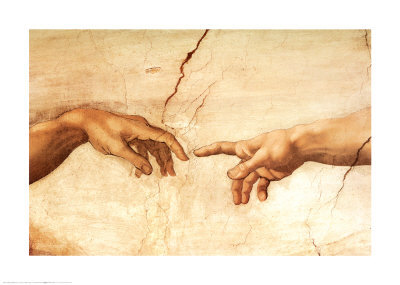
"I don't know how to love Him."
Jesus Christ Superstar
"In the end, however naked, tall, there is still
The impossible possible philosophers' man,
The man who has had the time to think enough,
The central man, the human globe, responsive
As a mirror with a voice, the man of glass,
Who in a million diamonds sums us up."
Wallace Stevens, "Asides on the Oboe"
In my current reading (Melvin Konner's The Evolution of Childhood) I came across the sentence, "Religion is largely about relationship" (p. 671). Initially this took me aback as an extraordinary claim (isn't religion also about history, narrative meaning, social tradition, and morality?), but I realized it wasn't, for a couple of reasons. For one, I had implicitly but mistakenly read it in the impoverished sense in which "relationship" is used in contemporary popular culture.
Perhaps this was because in a local show last night the great Iris DeMent, chatting between songs, talked about her 92-year-old mother, who, after watching Oprah on relationships, said something like, "I'm not sure I even know what a 'relationship' means" (she had been married for 50-odd years and borne 14 children). In common parlance "relationship" is inextricably and often trivially tied to romance and dating, generally in the sense of novelty and excitement. In a couple of paragraphs I'll speculate on why that might be.
But Konner was merely stating the obvious in this case in the sense, which I've written about before, that religion is primarily about emotional needs, not metaphysical conviction. God serves vital interpersonal functions on two levels, providing both an idealized, all-accepting Other as well as a real and connected community of believers focused on that Other. While religion obviously is diverse, even a supposedly atheistic "faith" like Buddhism generated over the millenia a massive emphasis upon the figure of Buddha himself, arguably a God-substitute. While a tiny minority of "believers" may view God from an abstract perspective, for the vast majority of believers, religion is intensely personal. In a world of inevitably imperfect relationships (whether with parents, childrens, friends, or lovers), God is infinitely supporting and reliable. In psychoanalytic terms, as many have written, God is a superb "selfobject," the ideal that can also be related to (witness Christ as both God and human).
If the essence of religion is emotional and relational--if we may view it as a boat (an ark?) sheltering people on a threatening sea--it nevertheless requires a metaphysical anchor, that is, the being who is this idealized Other must be held to actually exist. Otherwise the whole enterprise is for naught. And it is this anchor, philosophically very shaky indeed, that has been the focus of most critics of religion over the millenia. But for most believers the intuition of the presence of this perfect Other is so obvious, so strong, so overpowering that it is impervious to argument. One may as well try to convince someone that he is not, in fact, in love with his beloved (perhaps Iago, one of the most despicable characters in all of literature, did pull this off with Othello, but it didn't turn out very well).
If religion were as universal among human beings as, say, language or sexual drive, then that would be end of story (Homo religiosus?). But while the great majority of human beings who have ever lived have been religious in some way, shape, or form despite arguably devastating philosophical objections to belief, it is of course the case that a minority of individuals, both now and throughout history, have been either implicit (i.e. agnostic) or explicit atheists. How do they manage relationships without the perfect partner who is God? Would a therapist in Scandinavia care to comment here?
To get back to Oprah, I wonder if "relationships" are so much the talk of the popular airwaves for the very reason that relationships are harder to maintain than ever. Not only religion, but the family and community have grown progressively more fragmented over the past century or two. Among other things, people turn on Oprah (another selfobject) as they might go to church. The anchor is loose, so the pressure to locate, attract, and keep (!) the "soul-mate" increases. When the Bible palls, family is distant, and the suburban street is empty, there is always eHarmony (or for Wallace Stevens, the poetic ideal). While neo-atheists such as Christopher Hitchens or Richard Dawkins are smugly confident, Nietzsche saw the death of God (as opposed to the Church, a very different animal) as undeniable and inevitable, but also as an immense tragedy for humanity, a tragedy past which we are still trying to feel our way.
Friday, September 25, 2009
Seek and Ye Shall Find
And for what, except for you, do I feel love?
Do I press the extremest book of the wisest man
Close to me, hidden in me day and night?
In the uncertain light of single, certain truth,
Equal in living changingness to the light
In which I meet you, in which we sit at rest,
For a moment in the central of our being,
The vivid transparence that you bring is peace.
Wallace Stevens
On an oppressively overcast morning in North Carolina, I seek and seek again for a subject (besides dissing popular social networking sites); I am answered, in the form of the phenomena of seeking and finding themselves. Dinah in a recent post at Shrink Rap, discussing the buzz over the pending publication of Jung's Red Book, wonders about the quasi-religious devotion of certain Jungians to their master. Specifically, she marvels, acknowledging a certain envy on her part, that some people come to feel that another human being has come up with the answers that matter in life.
There is fact and there is truth. Facts are the objectively verifiable states of affairs of history and science. Truth is a mode of living, whether individual or collective, that responds to deeply felt human needs. Fact is empirical; truth is subjective and spiritual. If needs change, truth may change as well, but facts won't. However, truth bears such conviction that it has a normative dimension; unlike, say, a mere preference for root beer, it cannot by its very nature be merely relative. Truth need not be totalitarian, but it stakes its claim and naturally seeks community. If I enjoy root beer, and it turns out that no one else on earth does, this fact may puzzle but not necessarily dismay me. But if I embrace moral, aesthetic, or spiritual truth that no one else in the world shares, I am made to feel sad and isolated. In contrast, if I am convinced of a fact that no one else in the world seems to see, I am made to feel mad.
Truth is another word for sensibility, whether individual or collective. Stephen Martin, the Jungian alluded to in Dinah's post, seems to have found in Jung's life and thought a corresponding truth and sensibility. Jung speaks to him as perhaps no one else does. This is an entirely different issue from the "evidence" (i.e. facts) that folks perennially try to muster to bolster the case for psychotherapy (often with an eye toward justifying reimbursement). This is not to say that psychotherapy can't have a factual dimension (e.g. exposure and response prevention may factually, on average, reduce symptoms of obsessive-compulsive disorder), but this is far afield from psychotherapy as mode of exploration and discovery.
The lucky ones, perhaps, are those who are so constituted as to find one Truth, or more realistically, a central Truth that towers over other truths as an effective spiritual colossus. That is what the conventionally religious achieve, as well as the figuratively religious, like Stephen Martin perhaps. Others must content themselves with myriad truths, like facets on a great gem whose center can only be imagined; undiscovered facets, and undiscovered gems, must be stipulated as well.
I have no Jung, no one human being or school of thought that organizes the world and my experience. Rather, I have many Jungs, men and women whose thoughts or creations I happen upon and think, "A century before I was born, this person knew me, anticipated me." This is truth by committee, albeit a transcendent committee of unherdable cats (truth is inescapably feline for me). I read somewhere that Bob Dylan once said that of his records Blonde on Blonde best captured a certain ineffable sound in his head; this was inseparable from his sensibility, from who he unavoidably was. I do not have primary creativity like that, so I must rely on others to evoke deeply shared experience.
So when people perpetually talk about great books or author lists, for me that really translates into a kind of personal pantheon of spiritual interlocutors, people--like me but vastly more creative and expressive--who could not help occupying at least part of the same truth. Among poets: Wallace Stevens, Emily Dickinson, Blake, Shakespeare. Among writers: Proust, Hardy, Dickens, Hawthorne, Melville, Dostoevsky, Chekhov, Tolkien, Loren Eiseley, Kafka. Among thinkers: Emerson, Thoreau, Kierkegaard, Nietzsche. Among painters: Kandinsky, Klee, Blake (again), Hopper, O'Keeffe, Brueghel. Among musicians: Beethoven, Schubert, Dylan, Neil Young. I tend to resist film, perhaps because I find that it colonizes consciousness too aggressively, but if I had to pick I would say Hitchcock, Woody Allen, and Stanely Kubrick.
And then there is the different need, for an actual, present, and living person who shares a sensibility, perhaps both reflected and refracted into a form only obliquely recognizable. Yes, there is that too.
Do I press the extremest book of the wisest man
Close to me, hidden in me day and night?
In the uncertain light of single, certain truth,
Equal in living changingness to the light
In which I meet you, in which we sit at rest,
For a moment in the central of our being,
The vivid transparence that you bring is peace.
Wallace Stevens
On an oppressively overcast morning in North Carolina, I seek and seek again for a subject (besides dissing popular social networking sites); I am answered, in the form of the phenomena of seeking and finding themselves. Dinah in a recent post at Shrink Rap, discussing the buzz over the pending publication of Jung's Red Book, wonders about the quasi-religious devotion of certain Jungians to their master. Specifically, she marvels, acknowledging a certain envy on her part, that some people come to feel that another human being has come up with the answers that matter in life.
There is fact and there is truth. Facts are the objectively verifiable states of affairs of history and science. Truth is a mode of living, whether individual or collective, that responds to deeply felt human needs. Fact is empirical; truth is subjective and spiritual. If needs change, truth may change as well, but facts won't. However, truth bears such conviction that it has a normative dimension; unlike, say, a mere preference for root beer, it cannot by its very nature be merely relative. Truth need not be totalitarian, but it stakes its claim and naturally seeks community. If I enjoy root beer, and it turns out that no one else on earth does, this fact may puzzle but not necessarily dismay me. But if I embrace moral, aesthetic, or spiritual truth that no one else in the world shares, I am made to feel sad and isolated. In contrast, if I am convinced of a fact that no one else in the world seems to see, I am made to feel mad.
Truth is another word for sensibility, whether individual or collective. Stephen Martin, the Jungian alluded to in Dinah's post, seems to have found in Jung's life and thought a corresponding truth and sensibility. Jung speaks to him as perhaps no one else does. This is an entirely different issue from the "evidence" (i.e. facts) that folks perennially try to muster to bolster the case for psychotherapy (often with an eye toward justifying reimbursement). This is not to say that psychotherapy can't have a factual dimension (e.g. exposure and response prevention may factually, on average, reduce symptoms of obsessive-compulsive disorder), but this is far afield from psychotherapy as mode of exploration and discovery.
The lucky ones, perhaps, are those who are so constituted as to find one Truth, or more realistically, a central Truth that towers over other truths as an effective spiritual colossus. That is what the conventionally religious achieve, as well as the figuratively religious, like Stephen Martin perhaps. Others must content themselves with myriad truths, like facets on a great gem whose center can only be imagined; undiscovered facets, and undiscovered gems, must be stipulated as well.
I have no Jung, no one human being or school of thought that organizes the world and my experience. Rather, I have many Jungs, men and women whose thoughts or creations I happen upon and think, "A century before I was born, this person knew me, anticipated me." This is truth by committee, albeit a transcendent committee of unherdable cats (truth is inescapably feline for me). I read somewhere that Bob Dylan once said that of his records Blonde on Blonde best captured a certain ineffable sound in his head; this was inseparable from his sensibility, from who he unavoidably was. I do not have primary creativity like that, so I must rely on others to evoke deeply shared experience.
So when people perpetually talk about great books or author lists, for me that really translates into a kind of personal pantheon of spiritual interlocutors, people--like me but vastly more creative and expressive--who could not help occupying at least part of the same truth. Among poets: Wallace Stevens, Emily Dickinson, Blake, Shakespeare. Among writers: Proust, Hardy, Dickens, Hawthorne, Melville, Dostoevsky, Chekhov, Tolkien, Loren Eiseley, Kafka. Among thinkers: Emerson, Thoreau, Kierkegaard, Nietzsche. Among painters: Kandinsky, Klee, Blake (again), Hopper, O'Keeffe, Brueghel. Among musicians: Beethoven, Schubert, Dylan, Neil Young. I tend to resist film, perhaps because I find that it colonizes consciousness too aggressively, but if I had to pick I would say Hitchcock, Woody Allen, and Stanely Kubrick.
And then there is the different need, for an actual, present, and living person who shares a sensibility, perhaps both reflected and refracted into a form only obliquely recognizable. Yes, there is that too.
Tuesday, May 19, 2009
All in Your Head?
To be in a Passion you Good may do,
But no Good if a Passion is in you.
William Blake
In a fascinating article on NPR, Barbara Bradley Hagerty considers evidence that neuroscientists are closing in on a physiological basis for spiritual experience. As always it is immensely complicated, but it seems to involve serotonin (which is influenced by LSD and other hallucinogenic drugs) and the temporal lobe (affected by some types of epilepsy). But in a sense the neurological details are irrelevant as compared to the ultimate question of whether spiritual experience is subjective or objective, whether it says more about us or about the world outside.
This relates to the primeval roots of philosophy. As I perceive my coffee cup, how can I be sure that it actually exists outside of me in the universe, rather than just as a physiological pattern in my brain? Sure, I can see it, touch it, drink coffee out of it, or break it, but all of these experiences are mediated by my brain--there is no way to know the coffee cup directly. This is related to the problem of philosophical (not political) idealism, or the dorm-room question, "How do I know I am not actually dreaming when I am not awake?"
Arguably and practically we settle this as a matter of consensus. We are irreducibly social beings, and so long as those around me, for instance, agree that there is a coffee cup on the table, I have no legitimate reason to question it. To be sure, these other people could also be mere phantoms of my brain (back to "life as a dream"), but so long as these people exist and behave according to consensually decided physical and psychological laws, this isn't really a problem.
As Hagerty's article mentions, it is agreed by most who actually reflect on the matter that all kinds of experiences near and dear to us exist as brain events. So, what about an experience such as love? Does the fact that love is biochemical in the beholding subject detract in any way from its attachment to the beheld object? Not at all. Love is as precious in the brain as it would be if it were off floating in the ether somewhere (much more so in fact). What matters is that the "love reaction" in the brain be reliably and meaningfully correlated with another person out in the world. If this reaction is set off by the sight of virtually any potentially available partner (the Don Giovanni phenomenon), then this is surely a problem, but it is psychological and relational, not biochemical or philosophical.
Love is an evaluative experience, and one that, significantly, we need not seek consensus for, so its subjectivity is not a difficulty. I do not need my fellows to confirm my experience by falling in love themselves with my beloved (indeed, this is the last thing I want). As such it is totally different from the matter-of-factly epistemological task of recognizing objective states of affairs in the world. Ethical and aesthetic phenomena partake of both aspects--consensually subjective attitudes are sought on the basis of consensually objective artifacts or moral outcomes.
The philosophical problem of most religious phenomena is that they combine both of these aspects, epistemological and evaluative, in a more questionable fashion. They postulate often quite specific states of affairs in the universe (e. g. it was created in such and such way, God has such and such attributes, did such and such) and also enjoin particular attitudes and evaluations that ought to follow from this (e. g. you must embrace this deity, you must avoid such and such actions). The problem, of course, is that while I can in practice get essentially 100% of my fellows to agree that there is a coffee cup on the table, I cannot arrive at anywhere near that degree of unanimity when it comes to cosmic states of affairs, at least beyond artificially organized subgroups.
This embarrassing situation prompts many liberal apologists to minimize theological speculations and focus on the emotional heart of spiritual experience. It is interesting that after one strips away theology and church doctrine, what is left is what Aldous Huxley called "The Perennial Philosophy," which is also what often accompanies hallucinogenic drugs and temporal lobe phenomena. That is, one arrives at a generally transcendent sense of plenitude, of the unity of beings and the universe, of a white light, and of ecstatic peace and acceptance. In other words, one arrives at the primal sense of love, but confusingly, without a clear love object.
Perhaps the history of conventional religion is the communal attempt to soothe this cognitive dissonance, to find--to create if necessary--a cosmic object worthy of this cosmic feeling. Needless to say, the project has had mixed results, but as for many that feeling (or perhaps more accurately, the need to have what Freud called the "oceanic" feeling, which I too have had) won't go away, the effort proceeds.
So the heart of religion, at its most barebones and austere, may be love of the universe. But if the universe is in fact the love object, then the project of knowing and specifying the beloved is science, and the act of praising the universe is poetry (by which I mean all the arts). Is there anything else?
But no Good if a Passion is in you.
William Blake
In a fascinating article on NPR, Barbara Bradley Hagerty considers evidence that neuroscientists are closing in on a physiological basis for spiritual experience. As always it is immensely complicated, but it seems to involve serotonin (which is influenced by LSD and other hallucinogenic drugs) and the temporal lobe (affected by some types of epilepsy). But in a sense the neurological details are irrelevant as compared to the ultimate question of whether spiritual experience is subjective or objective, whether it says more about us or about the world outside.
This relates to the primeval roots of philosophy. As I perceive my coffee cup, how can I be sure that it actually exists outside of me in the universe, rather than just as a physiological pattern in my brain? Sure, I can see it, touch it, drink coffee out of it, or break it, but all of these experiences are mediated by my brain--there is no way to know the coffee cup directly. This is related to the problem of philosophical (not political) idealism, or the dorm-room question, "How do I know I am not actually dreaming when I am not awake?"
Arguably and practically we settle this as a matter of consensus. We are irreducibly social beings, and so long as those around me, for instance, agree that there is a coffee cup on the table, I have no legitimate reason to question it. To be sure, these other people could also be mere phantoms of my brain (back to "life as a dream"), but so long as these people exist and behave according to consensually decided physical and psychological laws, this isn't really a problem.
As Hagerty's article mentions, it is agreed by most who actually reflect on the matter that all kinds of experiences near and dear to us exist as brain events. So, what about an experience such as love? Does the fact that love is biochemical in the beholding subject detract in any way from its attachment to the beheld object? Not at all. Love is as precious in the brain as it would be if it were off floating in the ether somewhere (much more so in fact). What matters is that the "love reaction" in the brain be reliably and meaningfully correlated with another person out in the world. If this reaction is set off by the sight of virtually any potentially available partner (the Don Giovanni phenomenon), then this is surely a problem, but it is psychological and relational, not biochemical or philosophical.
Love is an evaluative experience, and one that, significantly, we need not seek consensus for, so its subjectivity is not a difficulty. I do not need my fellows to confirm my experience by falling in love themselves with my beloved (indeed, this is the last thing I want). As such it is totally different from the matter-of-factly epistemological task of recognizing objective states of affairs in the world. Ethical and aesthetic phenomena partake of both aspects--consensually subjective attitudes are sought on the basis of consensually objective artifacts or moral outcomes.
The philosophical problem of most religious phenomena is that they combine both of these aspects, epistemological and evaluative, in a more questionable fashion. They postulate often quite specific states of affairs in the universe (e. g. it was created in such and such way, God has such and such attributes, did such and such) and also enjoin particular attitudes and evaluations that ought to follow from this (e. g. you must embrace this deity, you must avoid such and such actions). The problem, of course, is that while I can in practice get essentially 100% of my fellows to agree that there is a coffee cup on the table, I cannot arrive at anywhere near that degree of unanimity when it comes to cosmic states of affairs, at least beyond artificially organized subgroups.
This embarrassing situation prompts many liberal apologists to minimize theological speculations and focus on the emotional heart of spiritual experience. It is interesting that after one strips away theology and church doctrine, what is left is what Aldous Huxley called "The Perennial Philosophy," which is also what often accompanies hallucinogenic drugs and temporal lobe phenomena. That is, one arrives at a generally transcendent sense of plenitude, of the unity of beings and the universe, of a white light, and of ecstatic peace and acceptance. In other words, one arrives at the primal sense of love, but confusingly, without a clear love object.
Perhaps the history of conventional religion is the communal attempt to soothe this cognitive dissonance, to find--to create if necessary--a cosmic object worthy of this cosmic feeling. Needless to say, the project has had mixed results, but as for many that feeling (or perhaps more accurately, the need to have what Freud called the "oceanic" feeling, which I too have had) won't go away, the effort proceeds.
So the heart of religion, at its most barebones and austere, may be love of the universe. But if the universe is in fact the love object, then the project of knowing and specifying the beloved is science, and the act of praising the universe is poetry (by which I mean all the arts). Is there anything else?
Monday, March 9, 2009
Serenity Now

O reason not the need! Our basest beggars
Are in the poorest thing superfluous.
Allow not nature more than nature needs,
Man's life is cheap as beast's.
King Lear
Reading Judith Warner's latest column brought to mind Chekhov's haunting novella "Ward Six" (the ultimate there-but-for-the-grace-of-God story for psychiatrists). Warner muses on the (around these parts) contemporary craze for mindfulness, which has seeped into a good deal of the psychotherapy literature by now.
Warner frets, with a telling lack of complete mindfulness, that implacable attention to "the moment," and the remorseless casting aside of any concern that could be viewed as petty or as a potential distraction from the pursuit of Mindfulness, could have the effect of making one somewhat inhuman, or what would be worse, boring. And to the truly mindful, having to tolerate (relatively mindless) family members and (ex?)friends could be like the recovering alcoholic having to sit through beer commercials. She postulates that being human may involve being a bit "ragged" from time to time.
As a non-Buddhist but one long fascinated by that mindset, these wry concerns ring true. If I understand Buddhism correctly, the source of all suffering is desire; one follows surely from the other--extinguish desire and, one, hopes, relieve suffering. But given that, as Buddhist monks ably demonstrate, all we absolutely need is a cell, a robe, water, and bread, what justification can there be for maintaining further desires at all? If thy eye offend thee...Of course, desire (and I'm not talking (just) about a new Lexus here, but desire for family closeness, world peace, whatever) is also arguably one's reason for living. That offensive eye provides vision; if it doesn't, maybe it should indeed go, as should desire if it no longer justifies life.
The Buddhist move is much like the colloquial philosophical move of "the grand scheme of things." We do this all the time to maintain perspective in life. A guy cuts me off in traffic--is it ultimately, in the grand scheme of things, worth it to me to murder him? "Don't sweat the small stuff," we say. The problem with this as a general move is that from the standpoint of the universe, nothing we do or care about matters. In the grandest scheme possible, the earth vanishes in five minutes--doesn't matter.
No, things matter at all only in a contingent way and according to how we happen to be constituted as conscious animals with a long evolutionary history. For our own individual and social well-being we somehow manage, singularly and consensually, to work out what "really" matters. But it may be unwise to say that this happens primarily as the work of the solitary, determined, and mindful self. It is a spiritual project, and one that culture ought to refine and not coarsen.
All this reminded me of Stoicism, Chekhov and "Ward Six." The doctor is trying to convince a skeptical patient of that Greek wisdom:
"There is no real difference between a warm, snug study and this ward," said Andrey Yefimitch. "A man's peace and contentment do not lie outside a man, but in himself."
"What do you mean?"
"The ordinary man looks for good and evil in external things--that is, in carriages, in studies--but a thinking man looks for it in himself."
"You should go and preach that philosophy in Greece, where it's warm and fragrant with the scent of pomegranates, but here it is not suited to the climate. With whom was it I was talking of Diogenes? Was it with you?"
"Yes, with me yesterday."
"Diogenes did not need a study or a warm habitation; it's hot there without. You can lie in your tub and eat oranges and olives. But bring him to Russia to live: he'd be begging to be let indoors in May, let along December. He'd be doubled up with the cold."
Let the storms of life rage! The mind cares not, nestled as it is in its dark, moist womb of bone. Ah, high-maintenance humanity, both cursed and blessed with a limbic system and a midbrain, not to mention everything from the neck down...I would say that as a society we show little sign yet of becoming morbidly mindful.
Monday, March 2, 2009
Material Objections
"You don't believe in me," observed the Ghost.
"I don't," said Scrooge.
"What evidence would you have of my reality beyond that of your senses?"
"I don't know," said Scrooge.
"Why do you doubt your senses?"
"Because," said Scrooge, "a little thing affects them. A slight disorder of the stomach makes them cheats. You may be an undigested bit of beef, a blot of mustard, a crumb of cheese, a fragment of an underdone potato. There's more of gravy than of grave about you, whatever you are!"
"A Christmas Carol"
Two links on freedom and belief:
1. Courtesy of Arts & Letters Daily, an intriguing article on the brain's reward system describes the case of a woman who suddenly developed pathological gambling after taking dopamine for Parkinson's disease. This sort of story punctures our more overblown conceptions of free will (as did the obesity post a few days back), even if we can't do without some form of it, albeit perhaps in shrunken form.
The article also argues that gambling, including that heretofore respectable form of the stock market, deprives the dopamine system of its rationale by disconnecting effort from emotional reward. Throughout evolutionary history effort did not always pay off, obviously, but effort and skill were proportional to success--spearing the prey or winning the girl or guy--often enough to make dopamine's rewards meaningful. Both gambling--by making the payoff random--and drugs such as nicotine and cocaine--by making the payoff guaranteed--short-circuit the meaning-making function of the dopamine system.
2. At A Commonplace Blog D. G. Myers mounts a worthy defense of theism and tolerates my agnostic remonstrations. As usual, I argue that the quandary is not belief in God in the abstract, but rather the extreme multiplicity of religious conceptions across geography and history; absent the accidents of disposition and upbringing, there is no compelling justification for specifying God beyond the ultimately absent and inscrutable place-holder of value. That is, we cannot justifiably specify God in sufficient detail for belief in "Him" to make specific moral or metaphysical differences in our lives. We are left with mere wonder.
"I don't," said Scrooge.
"What evidence would you have of my reality beyond that of your senses?"
"I don't know," said Scrooge.
"Why do you doubt your senses?"
"Because," said Scrooge, "a little thing affects them. A slight disorder of the stomach makes them cheats. You may be an undigested bit of beef, a blot of mustard, a crumb of cheese, a fragment of an underdone potato. There's more of gravy than of grave about you, whatever you are!"
"A Christmas Carol"
Two links on freedom and belief:
1. Courtesy of Arts & Letters Daily, an intriguing article on the brain's reward system describes the case of a woman who suddenly developed pathological gambling after taking dopamine for Parkinson's disease. This sort of story punctures our more overblown conceptions of free will (as did the obesity post a few days back), even if we can't do without some form of it, albeit perhaps in shrunken form.
The article also argues that gambling, including that heretofore respectable form of the stock market, deprives the dopamine system of its rationale by disconnecting effort from emotional reward. Throughout evolutionary history effort did not always pay off, obviously, but effort and skill were proportional to success--spearing the prey or winning the girl or guy--often enough to make dopamine's rewards meaningful. Both gambling--by making the payoff random--and drugs such as nicotine and cocaine--by making the payoff guaranteed--short-circuit the meaning-making function of the dopamine system.
2. At A Commonplace Blog D. G. Myers mounts a worthy defense of theism and tolerates my agnostic remonstrations. As usual, I argue that the quandary is not belief in God in the abstract, but rather the extreme multiplicity of religious conceptions across geography and history; absent the accidents of disposition and upbringing, there is no compelling justification for specifying God beyond the ultimately absent and inscrutable place-holder of value. That is, we cannot justifiably specify God in sufficient detail for belief in "Him" to make specific moral or metaphysical differences in our lives. We are left with mere wonder.
Sunday, January 25, 2009
Just This

Yesterday I visited a local Zen center for the first time since moving here a few months back, and I was thinking this morning about subtle correspondences between Zen meditation and classical psychoanalytic practice. As psychological technologies, they are like half-siblings, sharing distinct affinities and oppositions. (I am neither a Zen devotee, exactly, nor an analyst, although I have long had an ambivalent fascination for both).
Both attempt to go beyond both everyday and logical concepts, which are viewed as limiting and distorting. In psychoanalysis, ordinary conceptual language is defensive and repressive, whereas in Zen language is mostly beside the point, an endless distraction. In psychoanalysis the instruments of language are turned ruthlessly upon language itself, in a kind of psychological self-vivisection; in Zen the swords of verbal intelligence are turned into the ploughshares of somatic awareness.
Suppose that you're looking for the needle in the haystack, where the needle bears a close resemblance to a piece of straw. In psychoanalysis, one painstakingly sorts through the hay, examining and comparing each piece exhaustively; in Zen, one steps back and focuses upon the haystack, appreciating the gleam of the sun upon it. The Zen question is: do you really need to find the needle in there? What if it doesn't exist? Even if it does, why do you assume it would make you happy?
Both psychoanalysis and Zen share a disconcerting austerity, a withholding of what we think of as the verbal and interpersonal creature comforts of life. No reassurance is to be had, only the paradoxical reassurance that one doesn't, finally, need reassurance. I therefore find in both a faintly sepulchral ambience: the reclining, quasi-solitary position of analysis, the still silence of Zen. Both are profoundly out of step with both conventional religion and consumerist (post)modernity.
Given the choice between an analytic hour, a meditation session, and some time with Shakespeare, I would always choose the latter. But the former have their own roles to play; how could we appreciate Falstaff without those elements that are opposed to Falstaff: iron discipline, limitation, and the void?
Friday, January 23, 2009
The Missing All

I know that He exists.
Somewhere -- in Silence --
He has hid his rare life
From our gross eyes.
'Tis an instant's play.
'Tis a fond Ambush --
Just to make Bliss
Earn her own surprise!
But -- should the play
Prove piercing earnest --
Should the glee -- glaze --
In Death's -- stiff -- stare --
Would not the fun
Look too expensive!
Would not the jest --
Have crawled too far!
Emily
I find Dickinson to be the most striking of poets because she inhabits the knife edge of agnosticism (about matters both metaphysical and theological), compared to which atheism is a cozy nook of fundamentalist certainty. From a purely external point of view, with respect to, say, church attendance or time spent in prayer, the agnostic and the atheist may appear indistinguishable, but subjectively there is all the difference in the world. Like any poet ought to, Dickinson sees this mystery, among other wonders, through fresh eyes, but with words that detonate upon reading, compounding gunpowder with the austerity of haiku. She may not have gazed upon God, but she sure did see the gaping God-shaped hole in the universe.
Jerry Coyne has written, in The New Republic, another devastating critique of both intelligent design and the often touted compatibility of religion and science. His lengthy but rewarding essay begins by reminding us that Charles Darwin and Abraham Lincoln were born on the very same day, February 12, 1809. The universe held its breath--can there have been any more world-historically significant day in the two centuries since? I will not attempt to summarize his trenchant analysis; a few comments will suffice.
Coyne notes that the fact that some scientists harbor conventional religious beliefs says more about the psychological inconsistency and talent for rationalization of human beings than it does about any real philosophical family resemblance. As he puts it:
True, there are religious scientists and Darwinian churchgoers. But this does not mean that faith and science are compatible, except in the trivial sense that both attitudes can be simultaneously embraced by a single human mind. (It is like saying that marriage and adultery are compatible because some married people are adulterers.)
Science does not directly disprove religion, but it has gradually removed the rational need for religion to attempt to explain any number of things about how the universe works. To be sure, there are things that science cannot explain, at least not yet, such as the origins of life or of the universe. But religion does not explain these either; it does offer purported descriptions of these origins, but this is not rational explanation, which depends on testability and experiment. To say that God created the universe is not to explain how the universe is created; it is, rather, to say, "Stop asking, in rational terms, how the universe was created."
Anyone who cares about psychology ought to take religion seriously, given that the great majority of human beings who have ever lived have been religious. The fact that a minority of people are unpersuaded no more undermines the centrality of religiosity to human nature than the occasional occurrence of voluntary celibacy negates the significance of sexuality. Religion arguably meets powerful needs for spiritual integrity of the self and the world, as well as underpinning morality and communal life. This is not to say that these needs cannot, some day, be met in different sorts of ways than they traditionally have been, but we ought not to overlook the needs themselves.
The problem, as Coyne writes, is that most religions go beyond moral, communal, and spiritual experiences to make specific empirical claims about the universe (involving, of course, creation, virgin births, heaven and hell, etc.). It is these claims that are specifically incompatible with science because they are immune to possible disproof by experiment (these claims have also led to much of the historical factionalism and violence that gives religion a bad name). The question is whether religion in the future can relinquish these empirical claims without losing its benignant influence for many people.
It's awfully hard to prove that something doesn't exist. Even so, I am virtually certain that, say, centaurs do not exist anywhere in the universe. I am so certain because the likelihood of intelligent life elsewhere (already a huge long shot of course) taking the form of such earth-generated mythological creatures is very close to nil, even if it cannot logically be shown to be zero.
I am very much less certain about God than about centaurs, largely because throughout history the notion of a supreme being has been so amorphous, and has taken so many diverse forms, that it is hard to know what we are talking about. In fact, it may be more accurate to liken the possibility of God not to any specified phenomenon such as a centaur, but to the potentiality of other intelligent life of whatever (in)conceivable form anywhere in the universe.
I personally have not encountered incontrovertible evidence, whether in my own subjective experience or available objective data, for the existence either of God or of extra-terrestrial intelligence. I cannot disprove their existence, and I have no interest in doing so, but I also don't go about my affairs under any specific assumption that they do exist. I try to do what's right, but I do it because it seems right, regardless of alleged supernatural justification. The fascinating and sometimes bewildering part is that while only a very small and eccentric fraction of my fellow human beings believe in UFO's, a rather large proportion of my earthly cohorts believe in God, so it behooves me to try to ascertain why that is and how we can all get along on this, the only world we really know.
Sunday, January 18, 2009
Solar Plexus

Busy, busy, busy...The best thing for a Sunday really seems to be plenitude, the sense that there is not merely enough for us, but more than we could possibly take in; and plenitude ought to lead naturally to gratitude. Five billion years old, and still blazing away with appalling violence, cushioned to a caress by distance and atmosphere.
So I leave you with this poem I like from Mary Oliver:
The Sun
Have you ever seen
anything
in your life
more wonderful
than the way the sun,
every evening,
relaxed and easy,
floats toward the horizon
and into the clouds or the hills,
or the rumpled sea,
and is gone--
and how it slides again
out of the blackness,
every morning,
on the other side of the world,
like a red flower
streaming upward on its heavenly oils,
say, on a morning in early summer,
at its perfect imperial distance--
and have you ever felt for anything
such wild love--
do you think there is anywhere, in any language,
a word billowing enough
for the pleasure
that fills you,
as the sun
reaches out,
as it warms you
as you stand there,
empty-handed--
or have you too
turned from this world--
or have you too
gone crazy
for power,
for things?
When it is so cold and dark this time of year it is easy to forget that such incomprehensible radiance is there, where it always was, for us.
Subscribe to:
Posts (Atom)