"I perceive I have not really understood any thing, not a single object, and
that no man ever can,
Nature here in sight of the sea taking advantage of me to dart upon me and
sting me,
Because I have dared to open my mouth to sing at all."
Walt Whitman
In puzzling over an unexpected suicide (and how many suicides are not, at some level, surprises?), we often ask empirical questions, as a detective might. How did this come about? Who or what is the primary culprit? But arguably the challenges suicide poses are chiefly existential and interpersonal, not factual. That is, the suicide, in rejecting life itself, dissents from values that we hold very dear.
And the question of "How could we not have known?" is more relational than epistemological. That is, suicide reminds us of the perturbing basic inscrutability of human relationships. If we do not know something so basic as whether someone is suicidal, what do we really know about them? That's why psychotherapeutic relationships can be the most intimate of all--not obviously in a physical sense, but in an existential one. The therapist often hears things that no one else in a person's life hears.
I just finished Jill Bialosky's History of a Suicide, which considers the suicide of her younger sister Kim some twenty years ago at the age of 21. It is a worthwhile and reflective addition to the suicide memoir shelf, but Bialosky is, like many, preoccupied with questions of causation. The problem is that completed suicide is complex and rare (relative to the numbers of the depressed); why would we expect suicide to be any more fathomable or predictable than other atypical behaviors, such as murder or sudden religious conversion? If we had the technology or insight to predict individual suicides, what other behaviors might we be able to foretell?
Bialosky seeks out a suicide specialist who tellingly conducts a "psychological autopsy," as if we can answer the dilemma of suicide using the tools of pathology. Unsurprisingly, a number of potential contributing factors come to light: a family history of mental illness and even suicide, a father who abandoned the family and ignored or rejected Kim, a depressed and withdrawn mother, an abusive boyfriend, and alcohol and drugs. This list is noteworthy for its obviousness and for the fact that every one of these things is objectionable in its own right even apart from any possible relation to suicide. The things we might do to reduce suicide risk--maintain family integrity, shore up communities, limit drug use, and increase awareness and treatment of depression--are things that we ought to be doing anyway. These influences ultimately tell us nothing, because we do not know which is necessary or sufficient.
The other thing that suicide teaches is how little we sometimes know of ourselves. It appears that a certain fraction of suicides, at least the final determination to act, are impulsive. If we could interview completed suicides after the fact, I suspect that a significant number would express surprise, if not dismay, that they actually went through with it.
Showing posts with label Suicide. Show all posts
Showing posts with label Suicide. Show all posts
Monday, June 6, 2011

Thursday, July 22, 2010
Calling Sir Galahad

"Nothing will come of nothing: speak again."
King Lear
An older fellow presents with chronic depression, personality disorder, social isolation, medical problems, and a deeply ingrained sense of bitterness and entitlement. However, he is highly intelligent, erudite, and possessed of an acidic, acerbic wit, making a session with him a bleakly endearing clinical approximation of reading Samuel Beckett.
He declares that while he has no imminent plan or intent, he deems it "92%" likely that within five years he will be dead "by my own hand." And yet, two minutes before the end of our meeting, he asks whether I know of any wisdom that he ought to keep in mind if or when the suicidal bug should bite him in the future. Interesting bit of intellectualization, that.
Ah, for a transcendent mantra that could tear the scales from the suicide's eyes and show the world in all of its eminently worthwhile glory! I'm thinking of a phrase that, when uttered, would silence the most raucous city street and bring the mighty to their knees, that would be like a compound of: the Holy Grail, the ultimate Om, fragments of the True Cross, the Philosopher's Stone, the meaning of Zen, the Ark of the Covenant, the Fountain of Youth, the proof of the existence (or non-existence) of God, the proof that Shakespeare wrote (or did not write) Shakespeare, the Theory of Everything, a perpetual motion machine, the Aleph of Borges, and the One Ring of Sauron (which, recall, did not permit its wearers to die).
But alas, that fantasy is akin to keeping a tower upright by proposing to blast it perpendicularly into space, when in reality its supports are far more prosaic, comprising deep-seated attachments between stone or steel and the earth from which they came. And of course that's what the request entailed: attachment, not anti-gravity thrust. "We'll talk about it next week."
Monday, July 19, 2010
David Foster Wallace Lives

Life, friends, is boring. We must not say so.
After all, the sky flashes, the great sea yearns,
we ourselves flash and yearn,
and moreover my mother told me as a boy
(repeatingly) 'Ever to confess you're bored
means you have no
Inner Resources.' I conclude now I have no
inner resources, because I am heavy bored.
People bore me,
literature bores me, especially great literature,
Henry bores me, with his plights & gripes
as bad as achilles,
who loves people and valiant art, which bores me.
And the tranquil hills, & gin, look like a drag
and somehow a dog
has taken itself & its tail considerably away
into mountains or sea or sky, leaving
behind: me, wag.
John Berryman, "Dream Song 14"
This poem, by a suicide who was also the son of a (paternal) suicide, came to mind as I was thinking more about David Foster Wallace. Even now, nearly two years later, I occasionally come across reflections on his demise, the shock and dismay of which still linger in the reading community. It occurs to me--as I'm sure it has occurred to many although I haven't actually seen mentions of it--that Wallace was the Sylvia Plath of this generation, the literary light snuffed out by the Black Dog.
There are obvious differences: gender, genre, and age--while Plath was only 30ish, Wallace was 46, and it's possible that his best work was already behind him in any event. But why did his suicide generate more consternation than the deaths of, say, Nathanael West or Albert Camus by motor vehicle at similar ages?
The inspirational quote by Wallace cited in Retriever's post of yesterday struck me perhaps because I had recently come across a very different sort of Wallace quote; the contrast of the two pretty much sums up the conundrum of genius and madness. The quote I mean was in Daniel Carlat's Unhinged (about which more eventually I'm sure), apparently an account of depression from a Wallace story:
You are the sickness yourself....You realize all this...when you look at the black hole and it's wearing your face. That's when the Bad Thing just absolutely eats you up, or rather when you eat yourself up. When you kill yourself. All this business about people committing suicide when they're "severely depressed": we say, "Holy cow, we must do something to stop them from killing themselves!" That's wrong. Because all these people have, you see, by this time already killed themselves, where it really counts....When they "commit suicide," they're just being orderly.
This is pretty grim and implacable stuff. Does anyone know a good joke? But really, black as it is, it is a spot-on description of severe depression. The difficulty of separating the illness from the self. The relentless but narrow logic of self-destruction. And Wallace is right in implying that suicide is merely a (final) symptom, and obstructing the symptom without addressing the disease is arguably unhelpful. Pre-empting a suicide is not in itself a solution to anything except insofar as it enables attention to underlying pathology.
In his book Carlat refers to Wallace in arguing that psychiatry still has a long way to go in terms of effective treatment. It is interesting that in the past decade or two, both the explosion of antidepressant advertising (especially on television) and the controversy over widespread medicating practices have fostered the notion that antidepressants are powerful drugs. That may have been part of the Wallace surprise--while people on the street still understand on some level that suicides still happen, the notion that in 2008, twenty years after the introduction of Prozac (the threat of which was thought to be that of making too many people "better than well"), a writer of the caliber of Wallace would go and kill himself seemed, well, so 19th century, or at least, so 1963.
Wallace and Plath also had in common the fact that neither suicide was, in purely clinical terms, surprising. Both had been hospitalized and had received ECT earlier in their lives. Plath was on an early antidepressant, and Wallace had been on many of them, including the monoamine oxidase inhibitor Nardil. I don't know the details of their treatment, but it appears they had plenty of it. While terminal cases are common (indeed inevitable, right?) in all areas of medicine, terminal psychiatric cases remain frustratingly abstract--we do not have the ominous scans, biopsies, or lab results that provide the paradoxical balm of the inexorable. Oh yes, we get a feeling that a certain case isn't likely to end well, but all we can do is fight on, calling the prognosis "guarded."
Suicide continues to shock, even as understanding of depression grows; a stigma persists. It is deemed "selfish" and demeaning, and that is on the whole probably a good thing. It keeps some people, I think, from reaching the point of no return. For as Wallace's quote argues, past that point, there is no weighing of potential alternatives, there is only a sense of overwhelming necessity, no more resistible than gravity. That is why involuntary commitment exists--logic has failed.
Just as suicide was long considered a sin against God, it continues to be seen by some as a sin against Life. The suicide rejects what most of us hold most dear, and there may even be a trace of egoism in this view, on two levels (not only "How could he consider himself too good for this world?" but also "How could he not want to be part of a world that contains...me?"). In social terms, suicide threatens to startle the horses in the street as the saying goes. I'm capable of viewing depression as medically as anyone, but this moral dimension means that depression will never be as simple a matter as diabetes--the former's sinister distant cousin is acedia, or willful blindness of the true light. As many have noted, the psychiatric/therapeutic office has an element of the confessional.
Monday, March 1, 2010
The Argument
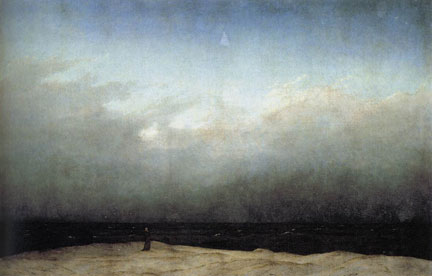
"Well then, my fine friend," said Mr. C..., "you now have all the knowledge you need to grasp my meaning. We see that in the organic world, to the same degree that reflection gets darker and weaker, grace grows ever more radiant and dominant. But just as two lines interesect on one side of a point, and after passing through infinity, suddenly come together again on the other side; or the image in a concave mirror suddenly reappears before us after drawing away into the infinite distance, so too, does grace return once perception, as it were, has traversed the infinite -- such that it simultaneously appears the purest in human bodily structures that are either devoid of consciousness or which possess an infinite consciousness, such as in the jointed manikin or the god."
"In which case," I observed, a bit befuddled, "would we then have to eat of the fruit of the tree of knowledge again to fall back into the state of innocence?"
"Undoubtedly," he replied; "which will be the last chapter of the history of the world."
"On the Theater of Marionettes," Heinrich von Kleist
On this remarkable account, humanity is an awkward absurdity as compared to the infinite grace of an unself-conscious plant. And yet humanity is redeemed by the possibility that it is in fact a point of transit on the way to something else, something infinitely better.
After a promisingly ingenious career, Kleist committed suicide in 1811 at the age of 34; what a disjunction between the life and the work. And yet the fact that any thumbnail sketch of him mentions the nature of his demise speaks volumes about the unique place of psychiatry. Whether a genius dies of leukemia, congestive heart failure, or tuberculosis we really couldn't care less. But suicide bespeaks far more than mere failure of the flesh, it suggests a moral claim, and a moral act with profound social implications. Just as social withdrawal implies a rejection of others, so suicide implies...a murdering of the human race. Killing oneself makes the rest of the human world disappear from consciousness too. That is why we view the suicide not only with pity, but also with consternation.
(It has been a fine day actually; this post just happened to strike me).
Sunday, May 3, 2009
Hippocrates and the Hangman

"Many that live deserve death. And some that die deserve life. Can you give it to them? Then be not too eager to deal out death in the name of justice, fearing for your own safety. Even the wise cannot see all ends."
Gandalf, The Fellowship of the Ring
Granted, when it comes to the question of capital punishment, those on death row tend in their character to be more like Gollum (for whom Frodo desires death in this Tolkien quote) than like Socrates faced with the hemlock in Jacques-Louis David's famous painting. And it is noteworthy as regards the quote that contemporary America endeavors to give (deserved) life to those fated to die every bit as aggressively as it seeks to give (deserved) death to those otherwise fated to live after committing heinous crimes. In this respect capital punishment is a grim mirror image of the out-of-control medical-industrial complex. Even the wise...
This came to mind after a recent local story in which the Supreme Court of North Carolina decided (4-3!) that the state medical board cannot in fact discipline physicians who participate in executions (i.e. by monitoring vital signs to insure that the inmate is "not suffering"). Death sentences, which had been on hold for a couple of years because of this question, can presumably start up again.
It took me years to decide where I came down on the question of the death penalty. I used to be for it, as I've always had a healthy respect for evil as a real force in the world, and as Tolkien wrote, in terms of abstract justice there are people who have done things so awful that they deserve to die. However, in an odd parallel to the question of the possible rationality of suicide, I think that the absoluteness of death precludes, in practice, the ethically justifiable intentional taking of life for any reason but direct and obvious self-defense (any society-wide deterrent effect of capital punishment is debated, and is definitely not direct and obvious).
Capital punishment, like suicide, is a declaration that this particular person's life cannot be considered worth living; in an execution the state effectively commits suicide on another's behalf, conflating vengeance and penance. In this sense it is richly ironic that those on death row are not permitted to commit suicide, and indeed may not be considered "competent" for execution if they are suicidal. Both execution and suicide are acts of dreadful certainty: "By the permanence of this act I affirm that I (or we, the state) cannot possibly be mistaken, that things could never come to be different, whether through additional evidence or altered perception." Playing God, indeed, although to do so with someone else's life is rather different, isn't it, than to do so with one's own?
What physician would want the job of monitoring an execution? I suppose it could be a deeply ethical act, inasmuch as the about-to-be-executed are, by definition, those who have had every human right stripped from them--except for the right to freedom from inflicted physical agony. Another irony, as Atul Gawande's recent New Yorker article painfully described, is the regular use of long-term solitary confinement, which arguably inflicts emotional distress far more horrific than the physical pain someone could undergo during lethal injection. What is the difference? Well, there are media and family representatives observing an execution, but in a solitary cell, not so much. Very discreet.
I always come back to Oliver Cromwell's (paraphrased) admonition, "I beseech you, in the bowels of Christ, consider that you may be mistaken." Suicide means blinding oneself to the possibility of the ultimate error. Execution leaves this possibility open, but removes the option of ever rectifying it. Eventually the civilized world will view capital punishment much in the way it views slavery, as beyond the pale (much of the world does already actually, we just haven't joined it yet).
Tuesday, December 23, 2008
That is the Question
"There is only one really serious philosophical question, and that is suicide."
Albert Camus
Morbid though it is before the holidays, I feel obliged to finish the thought from last post, about how the ultimate ethical issue of suicide is similar to other grand queries (why be moral? why grow up?) that lack a fully satisfying theoretical answer. And in practical and clinical terms, is it possible, or even advisable to try, to dissuade someone who is seriously suicidal?
But this gives me a chance to touch on "holiday psychiatry" in general. As many hopefully are aware by now, the notion that the suicide rate increases around the holidays is a myth (it actually has a spike in the spring), although some have expressed concern that the dramatic economic downturn may generate more risk this particular year.
While many people complain about the increased stress of the holidays, and certain individuals do indeed fare worse this time of year, in my clinical experience the net effect is positive. In my years of inpatient work the unit census always dipped dramatically the latter half of December. And outpatients--again, on average--seem to coast through holiday time reasonably well.
My hypothesis is that while many may gripe about tedious or irritating family time, the social support of sheer enforced togetherness is usually a good thing (time off from work doesn't hurt either). In this way, family time can be like, well, a very different but well-known kind of social encounter: it may be far from perfect, but it is better than none at all.
At any rate, let's suppose someone is in fact driven to the brink by depression plus the holiday fanfare. As hinted above, philosophers have had a hard time coming up with solid justifications for why suicide is generally an evil. Presumably, the reason is that in order to work, such arguments have to assume too much of what they're trying to prove, that is, the absolute value of life itself.
Any philosophical argument presupposes an adequately rational auditor, and that is the problem--a seriously suicidal person, virtually by definition we say, has lost sight of his or her own vital interests and therefore cannot be considered fully rational. That is why we have involuntary commitment procedures and locked psychiatric hospital wards, because for suicidal individuals reason has broken down.
Fortunately of course, most people make it through life without being constitutionally disposed to seriously suicidal thoughts or behaviors. So native biology is our first and primary protection, but not the only one by far. What are the most common reasons not to commit suicide? The following is not scientific, but based on my clinical observations:
1. Cowardice--Fortunately most people are sufficiently averse to violence, pain, and blood that this in itself will keep many in the land of the living; there is also the associated fear of doing something halfway and winding up brain-damaged. If some absolutely painless and definite means of suicide were widely available, that would make the psychiatrist's job considerably harder. This is a visceral factor that few potential suicides need reminding of.
2. Threat of damnation--Whatever else one might say about religious belief and psychiatry, hell serves--among believers obviously--as a mighty deterrent for many would-be suicides. This consideration is also the basis for one of the most famous passages in English, Hamlet's "To be or not to be" soliloquy. However, most people for whom this rationale has force will have arrived at it long before they talk to a psychiatrist, so I wouldn't usually bring it up (if I know a suicidal someone to be a believer and yet he doesn't volunteer the damnation concern, I will usually ask something like "Have you shared this with your minister, etc.?"). In fact, suicide is such an absolute ethical issue precisely because death is, so far as we know, so final; in the broadly secular context of psychiatry, to emphasize considerations of the afterlife would be positively counterproductive for this reason (again, if someone already has a belief in hell or whatever that protects against suicide, that's great with me).
3. Effects on family--Many potential suicides will already have this preventive concern in place. But sometimes not--depression is, almost by definition, a state of self-absorption such that the ramifications for children, parents, etc. will have been overlooked. For this reason I often try, sensitively and without imputation of a "guilt trip" for their own suffering, to convey the devastation that suicide can wreak in families through the generations.
4. This too shall pass--This is the consideration that seriously suicidal people are least likely to have perceived, and therefore one that I most emphasize. In most cases depression is an episodic illness; when it flares it can be awful, but relief is likely to come (even without treatment, although treatment obviously hastens recovery). And yet the deeply depressed person, by the nature of the illness, cannot imagine this--all they can see is darkness (that's what true hopelessness is). So the way I usually think of it is that suicide is a permanent solution for a temporary problem, and I remind people that their own values and their attachment to life will recover if they will only give it time.
Okay, I've had my say on that, and will come up with something appropriately rosier tomorrow.
Thursday, December 11, 2008
Grand Inquisitor

The heart asks pleasure first
And then, excuse from pain --
And then, those little anodynes
That deaden suffering;
And then, to go to sleep
And then, if it should be
The will of its Inquisitor
The liberty to die.
Emily Dickinson
Several items caught my eye today. It is dark and stormy here, with the potential for sudden catastrophic death looming over the landscape (okay, there's a tornado watch); so forgive the theme of menace.
1. On the brightest note, I was alerted to a comprehensive listing of psych-related blogs at "101 Fascinating Brain Blogs" at Online Education Database. It includes all the well-known ones but also many I wasn't aware of (oh, and it commendably includes Ars Psychiatrica).
2. Art Blog by Bob yesterday featured "The Scream" and several other works of the evidently dysphoric painter Edward Munch (painter of today's illustration here as well). Check it out.
3. For any readers in Kentucky I happened upon a Scientific American article about the United States Narcotic Farm (or Narco) near Lexington. From 1935 until 1975 the huge facility housed many of the nation's criminal addicts, which included some prominent names over the years. It was the setting for a great deal of addictions research involving the prisoners, although toward the end the C.I.A. and others apparently developed concerns that research involving both L.S.D. and less than fully informed consent may have been going on. The article includes a slide show and alludes to a documentary about Narco that would be very interesting.
4. Also in Scientific American is an article on schizophrenia and its relation to language. Schizophrenia is an enormously complex illness and we are far from understanding it, but given the prevalence of auditory hallucinations in the disorder, links to language function have long been a focus. Apparently genes related to language are increasingly suspected in schizophrenia, which may be a casualty of our species' very rapid brain growth over the past million years or so. It is odd to think of such a devastating illness deriving from the same developmental pathway leading to, among many other things, the great poets.
5. The New England Journal of Medicine has an editorial on the current status of physician-assisted suicide in the United States, now legal in both Oregon and Washington state after the latter recently approved it by a decisive 58-42 margin. With 6.7 million people, Washington is twice the size of Oregon and will be an interesting test of the law.
As the article documents, the procedure in Oregon has not drawn the multitudes that were originally feared. From 1998 through 2007 only an average of 34 patients per year carried out the procedure. The law requires two physicians to independently confirm that a patient is both terminally ill and competent to make the decision. As one would expect, the most common diagnosis was terminal cancer. The "physician assistance" usually involves prescription of barbiturates, which the patient apparently must administer himself.
No psychiatrist is required to be involved, although consultation with one is encouraged if there is any suspicion of depression or questionable competence. However, the article notes that no psychiatry consultations were made in 2007, and only 12% of cases involved consultations in the nine previous years.
I have pretty firm opinions on most issues, but this is one I struggle with. We know that suicidal ideation in general is much, much more likely to be related to a mental disorder (most commonly depression, substance abuse, or schizophrenia) than not, and we are familiar with concerns arising from end-of-life suicidality that may stem from inadequate palliative care or fears of being a burden on family members.
A philosophical question in psychiatry is whether suicidal ideation can be anything but a manifestation of disorder. The arguments pro and con are complex and beyond the scope of a blog post (Courtney S. Campbell wrote a heftier review of the issues in The New Atlantis), but I personally believe that it is possible for a terminally ill person, afflicted perhaps with irreversible physical or mental decline, to desire death without being considered clinically depressed.
However, considering the finality of suicide, and the issues of subtle or not-so-subtle suggestion or coercion that can arise, I wonder sometimes if we're making it too easy, too comfortable to make such an existentially stark decision. It may be hard for a psychiatrist to say, but it is a conscious being's inherent right to commit suicide. If someone tells me he's going to, then I will commit him to a hospital or otherwise take steps to prevent him. But if he doesn't tell me or anyone else, then no one is going to stop him.
The question is: why does he think he has a right to get someone else to help him? Some decisions are meant to be excruciatingly difficult and painful; that often means they shouldn't be made at all, or if they are made, certainly not with nonchalance. I think there is some risk to any society of allowing people to go too "gently into that good night." To me this seems the wisest and most conservative approach.
Thursday, August 7, 2008
Poetic Suicide
There is an interesting suicide poem, "Trouble" by Matthew Dickman, in the current The New Yorker. When one steps back and considers enough suicides, by different means in varying circumstances, it starts to seem dangerously anthropological in a way, as if suicide is just a behavior that self-conscious entities exhibit on occasion. People speculate about elephants and whales sometimes yielding voluntarily to death, but few things separate human beings from the rest of the animal world more starkly than suicide. Consciousness (or at least some neurological proclivity of which consciousness is an epiphenomenon) must have had major survival advantages over evolutionary time in order to outweigh suicide.
One alarming fact about psychiatry in the modern era (the past fifty years, when psychotropic medications have been more widely available) is the minimal impact on the suicide rate, which has hovered around 30,000 annually in the United Status for quite some time. Clearly there is much that we do not understand about suicide. Suicide has a grip on the social and historical imagination that far outweighs its actually impact on mortality; obviously one is much more likely to die of heart disease, cancer, or even an accident than from "self murder." In psychiatric practice it is striking to see the wide continuum of suicidal thinking and behavior. Of course, it is a truism that virtually all "normal" people occasionally have the thought of suicide cross their minds, particularly on a really bad day, but one useful boundarly marker of the grim realm of depression is a qualitatively different attitude toward suicide, which takes the form of a wan indifference to the attachments and rewards of life. Before one can pursue death one must first abandon life. As the conclusion of this poem suggests, this temptation must be resisted. Why? As every parent tells their children, "Just because."
One alarming fact about psychiatry in the modern era (the past fifty years, when psychotropic medications have been more widely available) is the minimal impact on the suicide rate, which has hovered around 30,000 annually in the United Status for quite some time. Clearly there is much that we do not understand about suicide. Suicide has a grip on the social and historical imagination that far outweighs its actually impact on mortality; obviously one is much more likely to die of heart disease, cancer, or even an accident than from "self murder." In psychiatric practice it is striking to see the wide continuum of suicidal thinking and behavior. Of course, it is a truism that virtually all "normal" people occasionally have the thought of suicide cross their minds, particularly on a really bad day, but one useful boundarly marker of the grim realm of depression is a qualitatively different attitude toward suicide, which takes the form of a wan indifference to the attachments and rewards of life. Before one can pursue death one must first abandon life. As the conclusion of this poem suggests, this temptation must be resisted. Why? As every parent tells their children, "Just because."
Subscribe to:
Posts (Atom)