Thursday, October 30, 2008

Spooky


"One can smile, and smile, and be a villain."

Hamlet


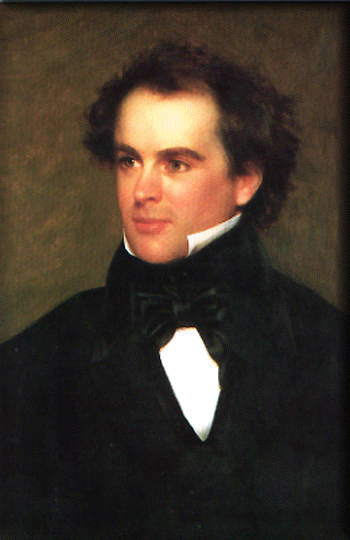
The political and literary parallels between Nathaniel Hawthorne (1804-1864) and Barack Obama are uncanny. Okay, perhaps I exaggerate. But I have been reading the former's short stories and the latter's Dreams From My Father, and they both tempt and test my ability to connect seemingly disparate characters. For one thing, the moral hazards of Hawthorne's fictions, no less than the pre-Election Day dread of some appalling Republican upset, demonstrate that there are far worse things to fear than goblins this Halloween.

Literary Hawthorne and political Obama strive to overcome two related bugbears: alienated apartness on the one hand and radical distrust on the other. And Hawthorne was more political than most fiction writers, while Obama is more genuinely a writer than most politicians. Both explore the dark regions of the soul, although Obama has had to suppress this inclination in favor of "sweetness and light" for the general election.

Compared to the very dark materials of his fictions, and compared with some of his famously eccentric contemporaries--Poe, Dickinson, Thoreau--Hawthorne was outwardly conventional, happily married and raising three children. He got into politics by penning a campaign biography of his college friend Franklin Pierce, who unfortunately turned out to be one of the worst presidents ever. Pierce was followed by James Buchanan, who was apparently just as bad, but Lincoln came next. If history were to repeat itself, we would have to endure another mediocrity before getting someone exceptional. Hmmm...

For Hawthorne isolation is both blessing and curse, the progenitor of both creativity and suffering. In a preface he wrote of his early years: "I sat down by the wayside of life, like a man under enchantment, and a shrubbery sprung up around me, and the bushes grew to be saplings, and the saplings became trees, until no exit appeared possible, through the entangling depths of my obscurity."

This may sound somehow magical and comforting, almost uterine. But at the end of "Wakefield," a disturbing story about a man's escape from domestic life, we read: "Amid the seeming confusion of our mysterious world, individuals are so nicely adjusted to a system, and systems to one another, and to a whole, that, by stepping aside for a moment, a man exposes himself to a fearful risk of losing his place forever. Like Wakefield, he may become, as it were, the Outcast of the Universe." For Hawthorne, human solidarity is so precarious that even momentary inattention or carelessness can send one spinning into the void, as it were.

Another anathema for Hawthorne's protagonists, yet always a temptation, is the prideful manipulation of humanity. This is termed the Unpardonable Sin in "Ethan Brand," and manifests itself as an overweening impatience with human imperfection in "The Birthmark." A witch seems to mock human beings by animating a scarecrow in "Feathertop," while magic fails to overcome human folly in "Dr. Heidegger's Experiment."

But reconciliation with the human race does not come easily in Hawthorne. The reason is the corrosive human propensity for iniquity and deception. The protagonist of "Young Goodman Brown" is devastated to learn the secret lives of those he previously put trust in, while "The Minister's Black Veil" is Junior High symbolism for hypocrisy. For Hawthorne as for Hamlet, the real zinger is not the fact of Evil itself, but the fact that it can hide so effectively from sight. The isolated individual withers, while solidarity is threatening.

The first part of Obama's Dreams From My Father eloquently yet without self-pity describes his childhood dismay at having to straddle black and white cultures (actually "brown" as well as the book puts it, with respect to the time he lived in Indonesia). He came to know alienation intimately. He tried to overcome this in part in his years as a community organizer in Chicago, but he was brought up short again and again by the brutal realities of human oppression, complacency, and corruption. It is the same "can't live with them, can't live without them" quandary.

In one telling dialogue, Obama describes his half-sister, Auma, expressing her dislike of politics. The reason? "People always end up disappointed" (p. 209). To me, this captures the fundamental political dilemma. In politics one is thrown together with others who may have radically different value systems and different points of view, and yet some kind of workable coexistence, or even better, consensus must be reached. One must overcome both alienation and distrust, and to my mind it is one of the harder things we attempt to do. Obama's story is a willed perseverance through both psychological and cultural obstacles in an attempt to reconcile with a society that he had every reason to be at war with. McCain's military courage and sense of honor are admirable, but Obama exhibits a moral resilience that originates in murkier psychological regions. Happy Halloween, and here's hoping for an illuminating Election Day and dispersal of our recent gloom.

Tuesday, October 28, 2008

Twilight Zone


"O, let me not be mad, not mad, sweet heaven,
Keep me in temper: I would not be mad."


King Lear


When a patient says, spontaneously and early in an interview, "I am not delusional," it could be either a good or a bad sign, prognostically, but it does portend an interesting session. Patients with schizophrenia or bipolar disorder are often in denial, but not typically in such an explicit and articulate fashion. Delusional Disorder is something of an oddity, a diagnostic stepchild. Patients suffering from it often have well-preserved cognitive and behavioral function, such that they are less likely to come to clinical attention than other psychotic patients. Age of onset is somewhat later, often middle age, and in my experience at least, women are more commonly affected.

In many cases of psychotic disorder the pathology hits you in the face, figuratively speaking; the question is primarily how to manage it, how to try to rebuild. If schizophrenia is a half-demolished city block, then delusional disorder is an outwardly unremarkable one: a little faded, perhaps, and somewhat deserted, but seemingly intact. Then suddenly you walk around a corner and nearly fall into a gaping sinkhole; picking up a volume of Thomas Mann, you open it and instead find a Kafka story. Or maybe it's more like stepping into an Escher print--no matter how far you seem to walk, you always end up where you started.

I find it uncanny at times to be with patients like this. It is as if our respective realities only partially overlap; the person seems only halfway within "my" usual epistemological universe. We witness the same states of affairs, in a literal sense, but we make totally different inferences from them. With other psychotic patients I don't really get this sensation. They may hear voices or they may think they're Jesus Christ, but they're either with me or they're not (in a metaphysical, not a moral, sense); patients with delusional disorder are half with me, half not, sort of like the Nazgul in Middle Earth (but without sinister implication). Maybe it's a bit like confronting a hologram--it seems like you could just reach out and connect, but you miss every time.

I thought of this for some reason the other day when I read a fascinating, and inexpressibly sad, profile (encountered by way of Arts and Letters Daily) of a family who perished in the Jonestown mass suicide in Guyana. If loving parents cannot get through to an only daughter in the grip of delusion, then who could? Fanaticism of all stripes as well as cult behavior provokes the same experience with me, the disconcerting feeling that some people may be physically next door but, in another sense, inhabiting parallel, and shocking, universes.

Monday, October 27, 2008

I Will Please (or Not)

I thought I'd weigh in on the doctors-prescribing-placebos story that caused some media stir at the end of last week. While some might view this issue as yet more evidence of the conspiratorial perfidy of the medical profession, I find it a fascinating window onto the dynamics of the clinical encounter, based on converging expectations of both physician and patient. It does, granted, reflect the persistent ethical naivete of doctors as well as an attitude carried over from a millenia-old tradition of paternalism.

The phenomenon is most relevant to the vast and--somewhat like the deep ocean, insufficiently explored--symptom pool of vague and recalcitrant complaints, unassignable to definite diagnosis, that constitutes much of primary care. No, I do not do primary care, but I live in close domestic proximity to an ER physician, and a good deal of ER practice these days is de facto primary care.

As the linked article implies, doctors are not generally prescribing true placebos, i.e. substances known to have no therapeutic activity such as sugar pills or IV saline solution. Rather, they are offering drugs, ranging from vitamins to antibiotics, that they themselves are skeptical will have a direct physiological (as opposed to psychological) effect.

I'm guessing that these interventions are not being made for clear-cut diagnoses with clearly indicated treatments, but rather for amorphous and mercurial syndromes for which no definitive clinical path is clear. If you're hopelessly lost in the woods and feel that you have nothing to guide you--no cell phone, no compass, no stars even--then you feel a need to pick some direction and start walking. Just step carefully and make sure you watch out for cliffs.

At some point in this age of technological overstretch, someone came up with the medical saying "Don't just do something, stand there." That is, sometimes inaction--watchful waiting--really is the best strategy. But it is one thing to do this in risky, high-tech, and acute situations and quite another to do it with chronic relapsing conditions in which people keep coming back again and again in search of relief. Paradoxically, "There is nothing more I can do for you" may be easier to say in cases of terminal illness than in cases of fibromyalgia, chronic back pain, or other long-term afflictions. In some particularly tough cases doctors desperately want to do something, and patients desperately want to get something, such that these expectations are mutually reinforcing.

I think there is no excuse for using non-indicated drugs that could have significant side effects, including antibiotics which could increase bacterial resistance in general. But consider the speculative case of a doctor prescribing a multivitamin for, say, chronic pain or fatigue. If pressed on whether the pill specifically targets the pathophysiology in question he would have to say, "I don't know" (if only because in many of these conditions the pathophysiology isn't really known). But he could honestly say that the pill has been helpful for others he has given it to (if only due to the placebo effect, a classic and potentially virtuous case of the self-fulfilling prophecy), and he could honestly say that a vitamin could decrease pain or fatigue by virtue of its overall effects on health or the immune system.

As some have mentioned, this practice, even when it does not (as in the case of multivitamins) involve significant side effects, does promote the general "pill culture" as a response to distress. But in this many bear culpability: doctors, patients, drug companies, marketers, the list goes on. Doctors need to be much more willing in general to say, "I don't know."

I don't know that this placebo trend has a counterpart in psychiatry, although it might if one includes it in the general category of the longshot. That is, with particularly chronic and refractory cases, I think a psychiatrist will sometimes resort to psychotropic medications that are not inappropriate, per se, but that he deep down has little confidence in, particularly in the difficult case in question. The side effects of this type of drug are generally quite minor, and seem a small price to pay to keep hope of relief alive. And the latter is not impossible--as with all hail Mary passes, "miracles" can happen.

Friday, October 24, 2008

The Best of Times...


"He knew what this thing was--hysteria, a snake whose scales are tiny mirrors in which the dead world takes on a semblance of life."


Miss Lonelyhearts


One of my early fascinations with psychiatry was the question of whether the problems we face are primarily "the thousand natural shocks that flesh is heir to" or whether they are largely of our own making. Of course, inasmuch as we are natural creatures, our soiling of our own nest is merely another "natural shock," but while this may be a cosmic comfort, the serenity prayer codifies our belief that wisdom is knowing what we can alter and what we can't. And the parallel question of perennial controversy is whether psychiatry itself makes things better or worse overall.

It is a time of extremes (a "bipolar" time indeed). Every generation in history has probably thought of itself as exceptional in some way, but we are different because we really are exceptional (ha). Our 63-year-old awareness that civilization as we know it could end in minutes (see Cormac McCarthy's The Road, but not if you're depressed) has been broadened to the increasingly visceral knowledge of the planet's potential environmental depletion and degradation. And yet by many other measures those who live today, excepting the billion or so of the absolute poor (a dreadful exception I know), enjoy greater comforts and advantages than most who have ever lived on the planet.

The current fascination with happiness and "positive psychology" suggests that we increasingly wonder whether we're better or worse off than our ancestors. It is interesting to me how many patients have brought this up spontaneously over the years. "Are more people stressed out these days?" I answer that many people wonder the same thing, but that no one really knows.

Pysch Central among many others reported on the recent 5% increase in the suicide rate in the U.S. between 1999 and 2005, an uptick that surprisingly occurred chiefly among middle-aged white men and women. Speculative causes that I read about included increased abuse of opiate pankillers (no longer a specialty of the young), the decrease in estrogen use after its risks were shown, and increased depression and PTSD among war veterans. It is discouraging that psychiatry's efforts in this respect make such a modest impact.

Psychiatrist Peter Whybrow, M.D. is reported as opining that our contemporary consumerist lifestyle has hijacked evolutionary drives that were once advantageous but may be no longer (sort of like cotton candy). Much as cocaine affects dopamine systems that were naturally selected for other purposes, our endless craving for more stuff (stoked of course by overheated, and I dare say underregulated, capitalism) only leaves us crashing, empty and wanting more. It is an interesting idea, even if the title of the linked article, "American Dream an Impossibility, Neuroscientist Says," sounds like a headline from The Onion.

Dear Abby has been around for a long time, but recent years have seen a proliferation of celebrity advice-givers and counsellors (for a while there Dr. Phil seemed to be everywhere), who constitute an "alternative" treatment within psychiatry every bit as much as St. John's Wort. One advice-giver I enjoy following is Dear Prudence (Emily Yoffe) at Slate, who almost always is, in fact, as wise as one would wish a therapist to be. Many of the stories people write in with, naturally, are (often ludicrous) family situations, but this week's entry contains a woman who asks for help with "self-loathing" unrelieved by conventional psychotherapy and medication.

To some degree the trend of alternative "therapy" represents dissatisfaction with mainstream psychiatry or even imperfect access to the same, but in a wider sense it could reflect a popular discontent, a feeling that our once common cultural bearings and guideposts are being lost. The most devastatingly satirical look at this phenomenon that I know of is Nathanael West's novella Miss Lonelyhearts, written interestingly in the 1930's (his Day of the Locust was a similarly spot-on treatment of celebrity culture). It is satire as transcendence; if Obama is our FDR (ha), who is our Nathanael West (who died young in a car accident)? Maybe David Foster Wallace? If his Infinite Jest (confessedly, as yet unread by me) could have been compressed to short-novel length, perhaps it could have had the white heat of Miss Lonelyhearts. But where is Wallace when we need him?

Thursday, October 23, 2008

Annals of the Prodigious


Here's a post from last night's news just for fun: the recent discovery of the longest known uninterrupted avian flight, by the bar-tailed godwit. The 7200+ mile journey from Alaska to New Zealand, which took eight days in the air without sleeping, eating, or drinking, beat the previous known migration record by over 3000 miles (not to stop even in Hawaii for a snack and a nap--that's impressive). Apparently it reflects an efficiency of energy production unsurpassed by any known vertebrate physiology. Can the godwit reduce our dependence on foreign oil? It is, alas, from Alaska.
What could it possibly be like to be a godwit, suspended above the sea for eight days and nights? It brought to mind, of course, a Dickinson poem:

A Route of Evanescence
With a revolving Wheel --
A Resonance of Emerald --
A Rush of Cochineal --
And every Blossom on the Bush
Adjusuts its tumbled Head --
The mail from Tunis, probably,
An easy Morning's Ride --

Big Spenders


Financial excess is certainly in the air these days--Wall Street, Vice-Presidential garb, and a topic for today, health care. This week's issue of The New England Journal of Medicine features two very straightforward and useful summaries of health care's systemic problems and potential solutions. Here are some take-away points as I understand them:


1. The most dire problem is not the uninsured, but rather the unsustainable growth of health care expenses.

2. Rising expenses are due largely to technical (and very costly) medical advances, although inefficiencies of care delivery play a role as well.

3. Resistance to change comes not only from partisan points of view, and from traditional American opposition to government administration, but also from the fact that the health care industry is itself a massive part of the economy. Millions of health care workers (including yours truly) depend on the status quo for their livelihood.

Potential solutions:

4. An independent oversight organization (such as Great Britain and other nations have) to assess effectiveness and cost-effectiveness of medical interventions.

5. Greater governmental involvement in the system to mandate efficiency, including wider use of electronic records.

(Basically, in order to have a system we can afford that provides adequate treatment for everyone, there is no avoiding elements of both rationing and (financial) compulsion).

The consensus on the campaign seems to be that neither candidate's plan seriously addresses these fundamental problems. Obama's is more generous but cannot realistically be paid for, while McCain's threatens to increase the numbers of the uninsured by undermining traditional employer-based coverage without providing reliable and affordable substitutes.

It all makes me glad I brought an apple for lunch.

Wednesday, October 22, 2008

Doctoring


"Everyone complains of a poor memory, no one of a weak judgment."


De La Rochefoucauld


Two psychiatry posts caught my eye yesterday, one by Peter Kramer, M.D. on the vagaries of prescribing, the other by Richard Friedman, M.D. on the strange phenomenon of patient-blaming. Between them they capture much of the art of the profession: balancing reported evidence against individual idiosyncrasy, and exercising patience leavened by humility.

Kramer points out that unless or until we have a much more advanced understanding of the genetics of drug metabolism, we will remain unable to predict how an individual will respond to any given drug with respect to both side effects and therapeutic effects. Doctors are guided by recommended ranges of doses, but patients vary wildly in their tolerance and reaction. One patient sleeps 24 hours after 25 mg of Seroquel, while another patient doesn't blink after 1000 mg. As someone somewhere said, the only difference between a medicine and a poison is the dose.

Many patients openly state they don't want "to be a guinea pig," but in a sense each singular clinical interaction must involve some "guinea pig" element because that particular constellation of factors--the doctor, the patient, the drug, the time, the diet, the other medications taken--have never occurred before in the history of the universe (and never will again). Of course, medications have been tested on large groups of other people such that we do have useful guidelines; we pretty much know that the person taking it won't drop dead 15 minutes later, and we know a lot more besides. But those large groups of other people are not exactly this person, so the potential for serendipity is considerable.

In choosing a medication we are hypothesizing that the range of remotely likely outcomes of taking it is preferable to the range of remotely likely outcomes of not taking it. We do not, of course, really know what will happen in either case; life is like that. A crystal ball would be a tremendous conversation piece in the office, but it would convey exactly the wrong idea (and of course few would get the irony anyway).

-----

Friedman delivers a message psychiatry seems in need of again and again: because of persistent crucial gaps in our knowledge we usually err in blaming patients for not getting better. It is true that factitious disorders and "secondary gain" exist, but these are vastly outnumbered by the cases in which people do not get better (or "fail" to get better, a frequently encountered word choice that itself speaks volumes) for physiological reasons we do not yet understand.

This is so problematic in psychiatry because we do not yet have access to the physical pathology involved. In other areas of medicine we can, via testing and imaging, witness the metastasizing tumor, the high blood sugar, the positive blood cultures. But in psychiatry all we usually have to go on is subjective report and observed behaviors. As Friedman describes, the bipolar who becomes refractory easily becomes, in the eyes of clinicians, the borderline.

Of course we also can't just treat people as physical phenomena; we must engage them as responsible agents as well. And the gray areas are fascinating: hysteria, personality disorders, addictions. We think now that addictions have a strong biological component, but what about willingness to attend AA or other appointments, or willingness to take medications? How do we decide when we are dealing with the illness and when we are dealing with the (accountable) person? We tack back and forth, I think, trying to find a fair and just middle way. But psychiatry teaches nothing if not humility, so when in doubt, which is often, it seems wise to spare the person and not the illness. I try not to be gullible either, but I'd rather be a little gullible than a little (or a lot) cynical--I seem to sleep better that way. Oh, and I try not to be sanctimonious either...